Licensed RNG baccarat is tested by independent laboratories and must meet the regulator's technical standards, for example AGCO's Registrar's Standards for Gaming in Ontario. Live dealer baccarat uses physical cards from a real shoe on camera. The game does not need to be rigged to be profitable for the house; the built-in 1.06%–1.24% edge does that transparently. The real risk is not a rigged shoe. It is playing at an unlicensed site with no dispute mechanism.
«A plain-English breakdown of baccarat reveals a simple truth: no streak or betting strategy alters the underlying house edge, but knowing the exact rules and commission structures protects your bankroll from unnecessary drag.» — Reid Calloway, Independent Casino Analyst
Last fact-checked: rules, payouts and the third-card tableau verified against licensed provider rulebooks (Evolution, Pragmatic Play) and regulator technical standards (Colorado Rule 28, Nevada Gaming Commission, iGaming Ontario) prior to publication.
Baccarat is a classic casino card game that has moved from high-roller land-based tables straight onto phone screens across Canada. It runs on fixed mechanical drawing rules, and that structure is exactly why baccarat offers some of the lowest house edges in online gaming: 1.06% on Banker and 1.24% on Player in standard 8-deck play, figures confirmed in peer-reviewed combinatorial analysis. This guide breaks down the core mechanics of the baccarat game, compares Player, Banker, and Tie bets, maps every major side bet and table variation, evaluates RNG and live dealer formats, and takes a critical look at the betting progressions you have probably seen promoted somewhere.
Quick Summary for Busy Readers
- Goal:bet on which hand, Player or Banker, will finish closest to a total of 9. You never receive cards yourself.
- Card values:Ace = 1; 2–9 = face value; 10, J, Q, K = 0. Totals are counted modulo 10 (7 + 8 = 15 → 5).
- Best bet:Banker at a 1.06% house edge, even after the 5% commission. Player sits at 1.24%.
- Worst bet:Tie, a 14.36% house edge at 8:1 odds. Avoid it as a staple wager.
- No Commission / Super 6 tables:removing the 5% fee raises the Banker edge to roughly 1.46%, because a Banker win on 6 pays only 0.5:1. Standard commission tables are mathematically better.
- Side bets(Pairs, Dragon 7, Panda 8, Tiger family, Lucky 7, Gold 7, Jade 8) pay 4:1 to 100:1 but carry double-digit house edges.
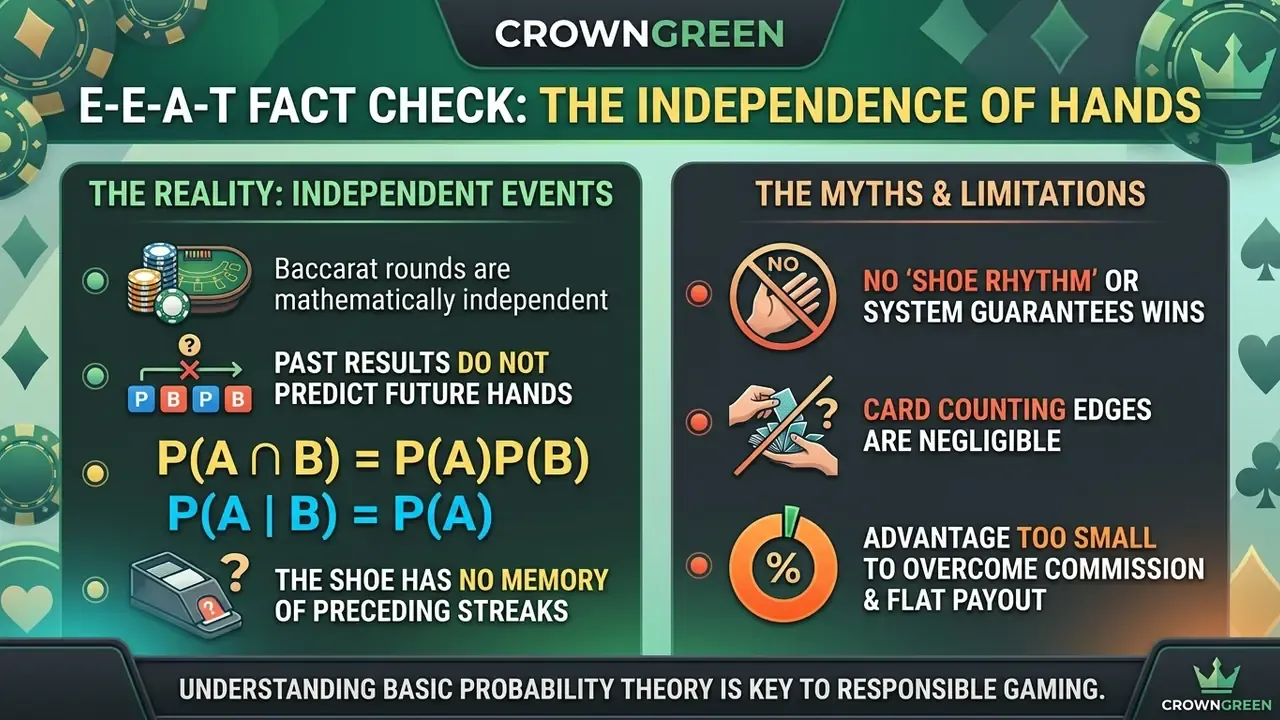
- Strategy reality check:Martingale, Paroli and Fibonacci change volatility, never expected value. Every hand is mathematically independent.
- Canadian practicality:confirm the licence (iGaming Ontario, BCLC/Loto-Québec provincial monopolies, or Kahnawake), check that baccarat contributes to wagering requirements, and prefer Interac e-Transfer for CAD cash-outs.
Why This Matters Before Your First Deposit
Most Canadians who look up baccarat online are not chasing a system. They want two answers: which bet costs the least, and will the money come back out. Both questions have concrete answers.
The house edge sets your long-run cost per dollar wagered. The operator's licence and payment rails decide whether a win becomes cash in your bank account. Get the first wrong and you overpay quietly. Get the second wrong and you might not get paid at all. This guide handles both, in that order.
What Baccarat Is and the Object of the Game
Baccarat is a comparing card game where the objective is to bet on which of two hands, the Player's hand or the Banker's hand, will finish closest to 9. Participants do not hold individual hands or make tactical in-game decisions. Instead, they wager on fixed positions before the dealer deals the cards. "Player" and "Banker" are simply the names of two betting propositions, not a description of who is playing against whom. That single point clears up most beginner confusion at the table.
The game's global footprint is enormous. Survey research profiling casino patrons in Macao found baccarat to be the single most played table game on the floor:

«Baccarat was the most popular casino game, played by 57.8% of surveyed casino patrons within the previous 12 months.» — To & Huang, Journal of Gambling Studies (2023). (DOI not supplied in source brief; figure quoted from the study abstract.)
In every baccarat casino round, values are calculated using modulo-10 arithmetic. Aces count as 1 point, cards two through nine keep their face value, while 10s, Jacks, Queens, and Kings count as 0 points. When the sum of the cards dealt exceeds 9, only the rightmost digit forms the hand score. If a hand receives a 7 and an 8, the sum is 15, so the official baccarat total is 5. A total of 0 is the lowest possible score (referred to as baccarat), whereas a total of 8 or 9 on the initial two cards is a natural. Comparison is absolute: a Player total of 7 beats a Banker total of 5, and identical totals produce a Tie.
Player, Banker and Tie Bets
Betting options in baccarat let you wager on a Player win, a Banker win, or a Tie result before the initial card deal. Each bet represents a distinct outcome in the baccarat game:
- Player Bet:a wager that the Player's hand will finish with a higher total than the Banker hand.
- Banker Bet:a wager that the Banker hand will finish with a higher total than the Player hand.
- Tie Bet:a wager that both hands will finish with identical point totals.

Because bets are placed on positions rather than on physical cards assigned to individuals, several participants at a baccarat online table can back the same outcome at once. A traditional big-table layout seats 12 to 14 players, each with their own Player, Banker and Tie betting boxes, with the dealer area positioned at the centre of the table.
How the Dealer Deals Two Cards to Each Hand
The dealer draws cards dealt alternately to form initial hands of two cards for both the Player and the Banker positions. Cards are dealt face up from a physical multi-deck shoe (typically 6 or 8 decks) or via a certified random number generator in digital online versions.
The opening sequence follows a strict order:
- The first card goes to the Player hand.
- The second card goes to the Banker hand.
- The third card goes to the Player hand.
- The fourth card goes to the Banker hand.
Once these two cards per side are on the layout, the dealer announces the totals. If either side holds a natural total of 8 or 9, the hand ends immediately, and all bets are settled without further card draws.

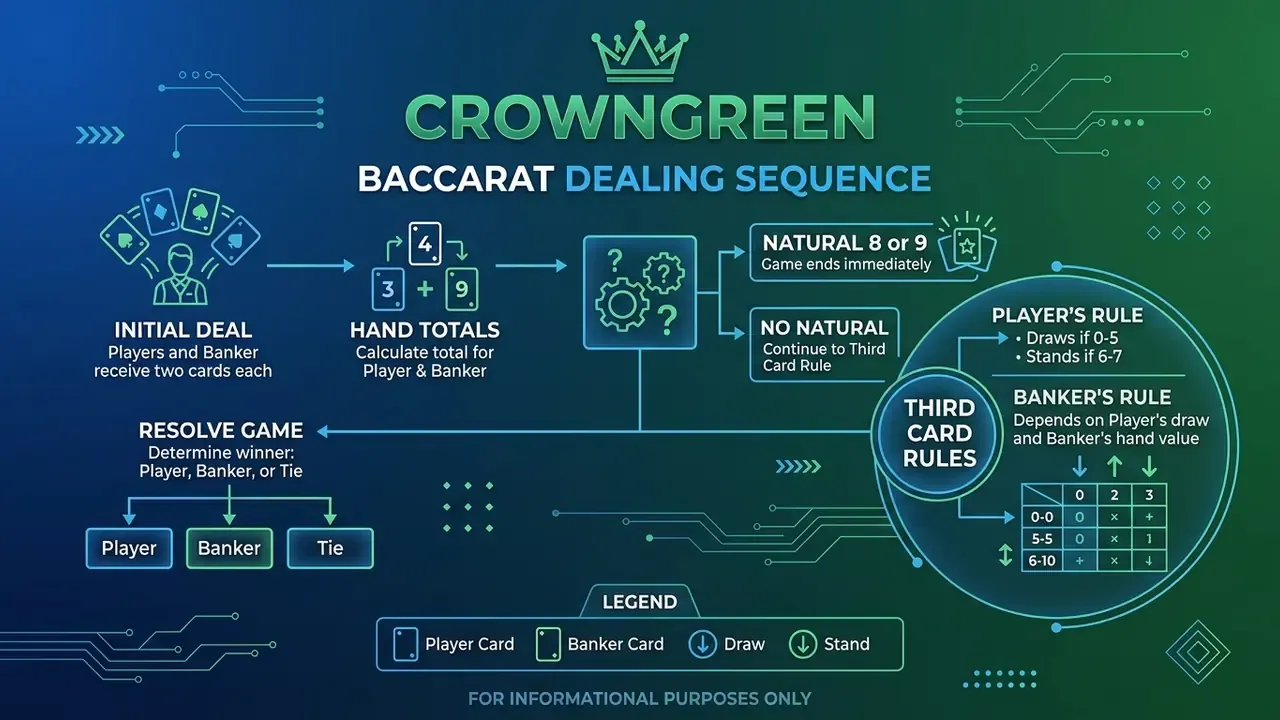
Semantic markup requirements: SVG diagram with a full text transcript inside the DOM: 1. Place your bet (Player / Banker / Tie) → 2. Cards dealt (two cards each to Player and Banker) → 3. Check for a natural (8 or 9) → 4. Third card drawn according to the tableau → 5. Compare totals and settle the winning hand. Alt text: "baccarat rules flow diagram".
Baccarat Rules: How a Hand Is Resolved
Standard baccarat rules dictate that hand totals are calculated immediately after the initial deal, which either triggers a natural win on 8 or 9 or invokes fixed third-card drawing rules. Neither the player nor the dealer makes discretionary decisions during the draw. Every action is governed by the fixed tableau. This is the core reason baccarat, in its casino form Punto Banco, is classified as a game of pure chance: the outcome is produced mechanically from the cards, not from decisions.
When the Player Hand Receives a Third Card
The Player's hand automatically draws a third card when its initial two-card total is between 0 and 5, and stands on a total of 6 or 7.
When evaluating the Player's score:
- Total 0, 1, 2, 3, 4, 5:the Player hand receives a third card.
- Total 6 or 7:the Player hand stands, no additional cards dealt.
- Total 8 or 9:natural hand; both sides stand, ending the round.
If the Player hand stands on 6 or 7, the Banker hand follows the exact same basic threshold: drawing on 0–5 and standing on 6–7.
The Third-Card Rule for the Banker
The dealer rule for the Banker third card depends strictly on the Banker's current two-card score and on the specific value of the third card drawn by the Player.
When the Player hand does not draw a third card, the Banker draws on totals 0–5 and stands on 6–7. When the Player hand does draw, the Banker follows a conditional rule matrix:
- Banker total 0, 1, or 2:the Banker always draws a third card.
- Banker total 3:draws unless the Player's third card was an 8.
- Banker total 4:draws if the Player's third card was 2, 3, 4, 5, 6, or 7.
- Banker total 5:draws if the Player's third card was 4, 5, 6, or 7.
- Banker total 6:draws if the Player's third card was 6 or 7.
- Banker total 7:the Banker always stands.
- Banker total 8 or 9:natural hand; no third card is drawn.
The Complete Third-Card Chart (Read It in Three Seconds)
Player hand tableau
| Player's first two cards total | Action |
|---|---|
| 0 – 5 | Draws a third card |
| 6 – 7 | Stands |
| 8 – 9 | Natural, stands, round ends |
Banker hand tableau (applies when the Player has drawn a third card)
| Banker's two-card total | Banker DRAWS when Player's third card is | Banker STANDS when Player's third card is |
|---|---|---|
| 0 – 2 | Any card | Never |
| 3 | 0, 1, 2, 3, 4, 5, 6, 7, 9 | 8 |
| 4 | 2, 3, 4, 5, 6, 7 | 0, 1, 8, 9 |
| 5 | 4, 5, 6, 7 | 0, 1, 2, 3, 8, 9 |
| 6 | 6, 7 | 0, 1, 2, 3, 4, 5, 8, 9 |
| 7 | Never, stands | All cases |
| 8 – 9 | Natural, drawing prohibited | All cases |
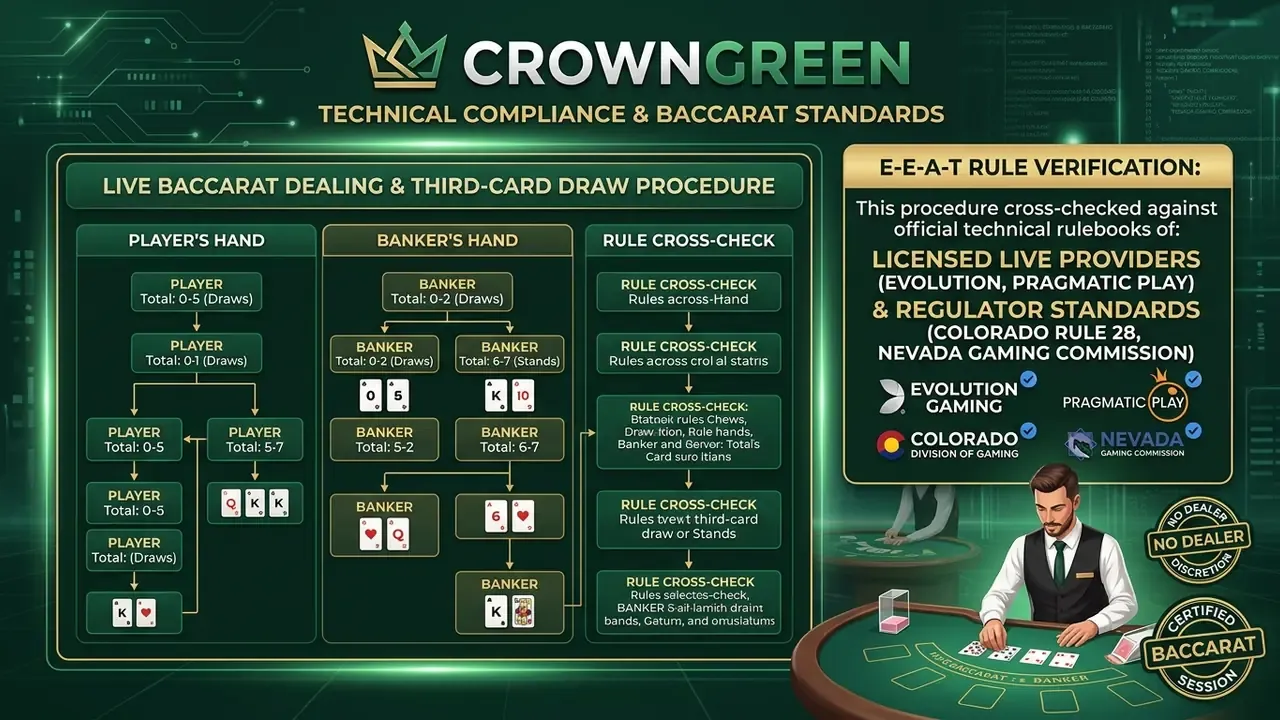
Worth remembering when someone at a live table insists the dealer "should have" drawn. The dealer has no vote.
Bet Types in Baccarat: Player, Banker, Tie and Commission
Baccarat betting features three main wagers, Player, Banker, and Tie, separated by payout ratios, winning probabilities, and a standard 5% commission on winning Banker hands.
How a Player Bet Differs From a Banker Bet
A bet on Player pays 1:1 with no deduction. A bet on Banker pays 1:1 minus a 5% commission, which reflects the Banker hand's statistically higher win frequency.
The Banker hand enjoys a structural advantage because its third-card rules act second, drawing with positional knowledge of the Player's third card. In an 8-deck shoe, the Banker hand wins roughly 45.86% of rounds, compared with 44.62% for the Player hand, and 9.52% of rounds end in a Tie.
«Banker's house advantage is approximately 1.06% and Player's 1.24%; the Tie bet at 8:1 carries an expected value of −0.239 per unit staked.» — Muto et al., Acta Psychologica (2025). https://doi.org/10.1016/j.actpsy.2024.104612
To balance the Banker's structural edge, casinos deduct a 5% commission on winning Banker bets. On a $100 winning Banker bet, the payout returns $195: the $100 original stake plus $95 net profit. At a physical table the dealer often tracks your commission on a running account, settled at the end of the shoe. Online, it is deducted automatically each round, which is one less thing to track.
When Players Choose Tie and No Commission Baccarat
Bettors choose Tie for the high 8:1 or 9:1 payout multiple despite a massive house edge. No commission baccarat removes the standard 5% fee by adjusting payouts on specific winning totals, most often a Banker win on 6 paying 0.5:1.
In No Commission Baccarat, winning Banker bets pay 1:1 for almost every outcome. But if the Banker wins with a point total of 6, the payout drops to 0.5:1, so a $10 Banker bet returns just $5 in profit. That single rule adjustment lifts the Banker house edge from 1.06% to roughly 1.46%, which makes standard commission baccarat mathematically friendlier over the long run. (Verification note: the 1.46% figure is derived from the published Super 6 / No Commission payout structure; the underlying probability distribution is documented in Muto et al., Acta Psychologica, 2025 — https://doi.org/10.1016/j.actpsy.2024.104612.)

| Bet type | Winning condition | Payout | Commission | House edge |
|---|---|---|---|---|
| Player | Player total > Banker total | 1:1 | None | 1.24% |
| Banker (standard) | Banker total > Player total | 1:1 (effectively 0.95:1) | 5% of winnings | 1.06% |
| Banker (No Commission / Super 6) | Banker total > Player total | 1:1 (0.5:1 on a winning 6) | 0% (offset by the "6" rule) | ~1.46% |
| Tie | Player total = Banker total | 8:1 or 9:1 | None | 14.36% (at 8:1) / 4.85% (at 9:1) |
Table notes: all house-edge figures assume a standard 8-deck shoe. On a Tie result, base Player and Banker bets are returned to the player as a push. Some Las Vegas properties, including The Venetian, pay Tie at 9 for 1, which materially lowers the Tie edge; most online tables pay 8:1. Read the paytable on the table you are joining instead of assuming a house standard. Paytables differ between two tables in the same lobby more often than people expect.
Side Bets in Baccarat: Full Payout Reference
Beyond the three core wagers, live-dealer tables and land-based pits offer optional side bets. They deliver far bigger multipliers, but almost all of them carry a house edge several times larger than the Banker bet. Treat them as entertainment spend, not as value plays.
| Side bet | Winning condition | Typical payout | Notes |
|---|---|---|---|
| Player Pair / Banker Pair | The first two cards of that hand form a pair | 11:1 (online standard) / 12:1 (e.g. The Venetian) | Double-digit house edge; payout varies by property |
| Either Pair | Either hand's first two cards are a pair | 5:1 | Lower variance version of Pairs |
| Perfect Pair | Pair of identical rank and suit | 25:1 | Rarest of the pair family |
| Dragon 7 (EZ / No Commission) | Banker wins with a three-card total of 7 | 40:1 | The same outcome pushes standard Banker bets in EZ Baccarat |
| Panda 8 (EZ / No Commission) | Player wins with a three-card total of 8 | 25:1 | Counterpart to Dragon 7 |
| Gold 7 (Ruyi Baccarat) | Banker wins with a three-card total of 7 | 40:1 | Banker main wagers push on a Gold 7 |
| Jade 8 (Ruyi Baccarat) | Player wins with a three-card total of 8 | 25:1 | Winning Player main wagers still pay 1:1 |
| Tiger | Banker wins with a total of 6 | 12:1 on two cards / 20:1 on three cards | Tiger family popularised at The Venetian |
| Small Tiger | Banker wins with a two-card 6 | 22:1 | Narrower condition, larger multiplier |
| Big Tiger | Banker wins with a three-card 6 | 50:1 | Highest-paying Tiger variant |
| Tiger Pair | Pair on either hand | 4:1 single pair / 20:1 double pair / 100:1 twin pair | Tiered pair proposition |
| Lucky 7 | Player hand totals exactly 7 | 6:1 on two cards / 15:1 on three cards | Offered exclusively at some properties |
| Dragon Bonus | Winning hand wins by a large margin, or natural win | 1:1 up to 30:1 | Payout scales with margin of victory |
Practical read: every side bet above costs more per dollar than the Banker bet, most of them by a factor of five to fifteen. If your objective is the lowest possible cost per hour of play, the mathematically consistent answer is to skip side bets entirely and flat-bet Banker. If you want the occasional high-multiplier moment, cap side-bet exposure at a small fixed percentage of your session budget, and never fund it out of progression logic.
Baccarat Variations and the Squeeze Mechanic
Modern online and land-based casinos run several distinct formats built on the same third-card tableau. Hand resolution never changes. Pace, table etiquette and the side-bet menu do.
- Mini-Baccarat. The fastest and most accessible format. The dealer performs every card action, players never touch the cards, table minimums are low, and a round usually resolves in under 30 seconds. This is the format most online RNG baccarat titles replicate.
- Midi-Baccarat. A mid-size table that reintroduces player handling. The participants with the highest Player and Banker wagers may touch or hold the hand they backed, and may squeeze or fold the cards, but not crumple or tear them. Midi tables also commonly offer the Pairs side bet at 11:1.
- Big-Table (Full-Size) Baccarat. The traditional 12–14 seat format historically reserved for high limits, where the shoe rotates around the table and players take turns dealing under the supervision of the croupiers.
- No Commission Baccarat. Removes the 5% Banker fee; a winning Banker hand totalling 6 pays only 1 to 2 (0.5:1). Convenient, but mathematically inferior to the standard 5% commission table.
- EZ Baccarat. Also commission-free, but instead of cutting the payout on 6, a Banker win with a three-card total of 7 becomes a push. That is precisely why the Dragon 7 and Panda 8 side bets exist on these layouts.
- Ruyi Baccarat and Midi-Ruyi Baccarat. Mini-Baccarat rules with no Banker commission, plus the Gold 7 (40:1) and Jade 8 (25:1) propositions. In the Midi-Ruyi version, the highest Player and Banker bettors gain the same card-handling and squeeze rights as at a Midi table.
- Speed Baccarat. A live-dealer variant compressing the round to roughly 27 seconds with no card squeezing. Faster rounds mean more decisions per hour, and therefore a larger absolute expected loss on the same stake. Pace is a bankroll variable, not a cosmetic one.
- Baccarat Squeeze. The ritual of slowly bending and revealing the edge of a card to build tension before the value shows. In live studios, Evolution's Baccarat Squeeze being the best-known implementation, several cameras capture extreme close-ups while the dealer performs the reveal. The squeeze changes nothing mathematically, since the card's value is already fixed, but it slows the round, which mechanically reduces hands per hour.
Etiquette note for live and land-based squeeze tables: if you hold the highest qualifying wager and are handed the cards, you may bend, peek and fold them face-down on the layout. You may not tear them, crumple them, or take them off the table, and you must expose both cards once you have finished. Not interested? Decline, and the dealer reveals the hand for you. Nobody minds.

Win Probabilities and What Actually Affects a Winning Bet
Probabilities for winning baccarat bets are set by eight-deck mathematical distributions: Banker at a 45.86% win rate, Player at 44.62%, Tie at 9.52%.
Why Banker, Player and Tie Must Be Evaluated Separately
Evaluating Banker, Player, and Tie separately matters because each bet carries its own combination of probability, payout structure, and house advantage. Averaging them together produces a meaningless number.
«Analysis of 17,970,830 baccarat games confirmed that, excluding ties, Banker wins 50.68% of resolved hands versus 49.32% for Player.» — Muto et al., Acta Psychologica (2025). https://doi.org/10.1016/j.actpsy.2024.104612
Despite the headline 8:1 payout on Tie wagers, the 9.52% probability yields an expected value of −0.239 per unit staked, which translates to a severe 14.36% house edge. Put plainly, the Tie bet costs roughly thirteen times more per dollar wagered than the Banker bet. That is why experienced baccarat players treat Tie as a novelty rather than a strategy.
Baccarat Formats: Online RNG, Live Dealer and Demo
Baccarat comes in three main formats: automated RNG online baccarat, real-time live dealer baccarat streamed from professional studios, and risk-free baccarat demo modes running on virtual credits. If you are still shortlisting operators, our comparative reviews of licensed online casinos break down which platforms carry each format, and at what limits.
Baccarat Demo for Learning the Rules
A baccarat demo lets you learn baccarat rules, watch the card dealing mechanics, and test the betting interface without risking real money.
Demo modes use simulated bankrolls, so Canadian players of legal gambling age (19+ in most provinces, 18+ in Alberta, Manitoba and Quebec) can test third-card drawing sequences, practise stake sizing, and see how different bets move a practice balance. No real money goes in or out, which makes demo play an educational sandbox and nothing more. One caveat worth internalising: a demo balance produces no emotional pressure, so a strategy that feels disciplined in demo mode often collapses at the first real-money losing streak. I have watched that happen to careful people.
Baccarat Live Dealer and Playing in a Live Casino
Baccarat live dealer games stream a real human dealer handling physical cards in a live casino setting, with interactive chat, squeeze mechanics, roadmaps and detailed scoreboards.
High-definition streaming captures card deals from studio tables in real time, with overlay controls for seat selection, chip placement, bet history and dealer chat. Large-scale behavioural data does urge caution, though:
«Live dealer table games exhibited higher risk profiles than RNG table games across behavioural markers of harm among 100,000 online gamblers.» — Delfabbro et al., International Journal of Mental Health and Addiction (2023). https://doi.org/10.1007/s11469-023-01012-w
Fast round pacing, social interaction and visual immersion can stretch session times and raise deposit frequency. The practical countermeasure is simple: decide your session length and loss limit before you sit down, not while the shoe is running.
| Parameter | Baccarat Demo | Online RNG Baccarat | Live Dealer Baccarat |
|---|---|---|---|
| Dealer present | No (automated) | No (certified RNG) | Yes, live streamed human dealer |
| Round speed | Player-controlled | Fast (instant settlement) | Moderate (27–45 sec/round) |
| Betting limits | Virtual credits only | $0.10 – $100 CAD typical | $1 – $10,000+ CAD typical |
| Side bets available | Depends on the title | Pairs, Dragon 7, Panda 8 | Full menu incl. Tiger family, Lucky 7 |
| Squeeze mechanic | No | No | Yes on Squeeze / Midi-style tables |
| Primary use case | Learning rules and the interface | Fast solo sessions | Authentic casino atmosphere |
Baccarat Strategy: Approaching Betting Without the Classic Mistakes
A sustainable baccarat strategy comes down to strict bankroll management and disciplined bet selection, and to rejecting negative-expectation progressions like Martingale, Paroli, or Fibonacci.
Martingale, Paroli and Fibonacci in Baccarat
Progression systems reshape short-term outcome distributions by adjusting stake sizes after wins or losses. What they cannot do is change the negative expected value of baccarat.
- Martingale System: doubles the stake after every loss, aiming to recover previous losses on the first win. The catch: exponential growth ($10 → $20 → $40 → $80 → $160 → $320) hits the table maximum or drains the bankroll during a losing streak. Seven consecutive losses from a $10 base already require a $1,280 eighth bet to chase a $10 profit.
- Paroli System: doubles the stake after every win, trying to ride a winning streak. The catch: one loss at the end of the streak wipes out the accumulated short-term profit. Its only genuine advantage over Martingale is that it risks house money rather than your reserve.
- Fibonacci System: increases stakes along the sequence (1, 1, 2, 3, 5, 8…) after losses, stepping back two places after a win. The catch: it accumulates risk during extended losing runs and recovers more slowly than Martingale, without removing house-edge drag.
«Positive and negative progressions are mathematical mirrors: both produce identical negative expected value equal to total wagers multiplied by the house advantage.» — Pflaumer et al., UNLV International Gaming Institute (2026). https://doi.org/10.1016/j.eller.2025.100012
Fact check on a widely repeated claim. Several casino-published guides say Martingale "works best when you have a substantial bankroll and the discipline to stick to the system." That framing is misleading, or rather, it is half a sentence pretending to be a whole one. A larger bankroll postpones ruin; it does not create an edge. Because each hand is independent and the house edge applies to every wager, a bigger bankroll simply means a larger total amount wagered, and therefore a larger expected loss in absolute dollars. Table maximums also hard-stop the sequence long before an "eventual win" is guaranteed. No staking pattern converts a negative-expectation game into a positive one.
[DISCLAIMER: this information is general in nature and does not constitute financial advice. None of the betting systems described guarantees profit, and none reduces the mathematical advantage held by the casino. If gambling has stopped being entertainment for you, support is available: ConnexOntario 1-866-531-2600, or the BC Problem Gambling Help Line 1-888-795-6111.]
Mistakes in Bet Selection and Chasing a Win
Common baccarat errors include chasing losses during a losing streak, overvaluing the high-edge Tie bet, ignoring the Banker 5% commission, funding side bets from progression logic, and falling into positive-recency trend-following traps on the scoreboards.
«Players exhibited positive recency, increasing wager sizes on outcomes matching observed streaks across more than 17 million baccarat rounds.» — Muto et al., Acta Psychologica (2025). https://doi.org/10.1016/j.actpsy.2024.104612
Because shoe deals are random, betting bigger on a developing trend only increases exposure to variance and speeds up losses. The five errors that cost Canadian players the most money, in order of how often we see them:
- Chasing losses, raising stakes specifically to recover a deficit, which amplifies total loss.
- Habitual Tie betting, accepting a 14.36% edge for an 8:1 headline payout.
- Ignoring commission, treating a Banker win as 1:1 when it nets 0.95:1, then switching to a No Commission table that is actually worse.
- Reading the roadmap as a forecast. Big Road, Bead Plate and Big Eye Boy displays are historical records, not predictive tools.
- No bankroll ceiling, playing without a pre-set session loss limit or deposit limit. That is the single strongest predictor of escalation.
What a defensible approach actually looks like: flat-stake the Banker bet at a standard 5% commission table, skip Tie and side bets or cap them at a token fixed amount, prefer slower tables over Speed Baccarat, set a hard session loss limit and a time limit in the account dashboard before your first hand, and treat the 1.06% edge as the honest price of entertainment rather than a puzzle to be solved.
How to Start Playing Baccarat: Demo, Real Money and Casino Offers
Starting baccarat play safely means picking a regulated Canadian platform, verifying its licensing credentials (iGaming Ontario, for example), testing the mechanics in demo mode, and reading bonus terms before you deposit real money in CAD.
Before funding an account, run through this checklist:
1
Verify licensing. Make sure the casino displays a valid licence from an official regulator: iGaming Ontario for the Ontario market, or the Kahnawake Gaming Commission. Cross-check the licence number on the regulator's public register rather than trusting a footer badge. Our directory of licensed Canadian casinos tracks which operators hold current registrations.
2
Check game contributions. Read the bonus fine print line by line. Baccarat bets often contribute only 5% to 10% toward wagering requirements, or are excluded outright. (These contribution bands reflect terms we have reviewed across Canadian-facing operators; the exact percentage is operator-specific and must be confirmed in the promotion's T&Cs, which are the governing document.)
3
Confirm the four bonus variables that decide withdrawability. Wagering multiplier, eligible games, maximum bet permitted while wagering, and any cap on withdrawable winnings. If one of those is unstated, treat the offer as unusable.
4
Confirm CAD payment methods. Check that the platform supports Interac e-Transfer or major e-wallets in Canadian dollars without foreign exchange conversion fees.
5
Set responsible limits. Set daily, weekly or monthly deposit limits inside your account dashboard before playing, and register for self-exclusion tools if you need a hard stop.
Our tested case, the bonus trap. Before committing real funds, our team assessed an online operator offering a $500 CAD table bonus. The T&Cs carried a 40x wagering requirement, and baccarat contributed only 5%. That works out to $400,000 CAD in total wagers before bonus funds could be withdrawn, a condition that quietly cancels potential wins for any normal bankroll. Skipping the bonus meant playing Banker directly, with instant Interac withdrawals and zero wagering restrictions. Sometimes the best offer is the one you decline.
«Browsing bonus pages when no bonuses were available was consistently associated with riskier live table-game play.» — Delfabbro et al., International Journal of Mental Health and Addiction (2023). https://doi.org/10.1007/s11469-023-01012-w

Canadian Payment Methods and Provincial Licensing
Baccarat mathematics is universal. The cash-out experience is not. Two things decide how smoothly a Canadian session ends: which regulator oversees your operator, and which rail your withdrawal travels on.
Provincial Regulation at a Glance
| Jurisdiction | Regulated offering | What it means for baccarat players |
|---|---|---|
| Ontario | Open private market registered with iGaming Ontario / AGCO | Widest selection of live and RNG baccarat from licensed private operators; disputes handled under AGCO standards |
| British Columbia | BCLC (PlayNow) provincial monopoly | Single provincial platform; land-based baccarat variants (Mini, Midi, Ruyi, Midi-Ruyi, No Commission) available in BC casinos |
| Quebec | Loto-Québec (Espacejeux) | Provincial platform; legal gambling age 18+ |
| Atlantic provinces | ALC (Proline+ / Atlantic Lottery) | Provincially operated online offering |
| Prairies | PlayAlberta, PlayNow Manitoba, Sask. lottery | Provincial platforms; Alberta and Manitoba are 18+ |
| Kahnawake (Mohawk Territory) | Kahnawake Gaming Commission | Long-standing licensing body used by a number of international operators serving Canadians |
Outside Ontario, provincial platforms are the only locally regulated option. Anything else is a grey-market offshore operator, where your recourse in a payment dispute is materially weaker.
CAD Payment Methods for Baccarat Bankrolls
| Method | Typical deposit speed | Typical withdrawal window | Notes |
|---|---|---|---|
| Interac e-Transfer | Instant to ~15 min | Same day to 1–2 business days | The Canadian default; native CAD, no FX conversion |
| iDebit / Instadebit | Instant | 1–3 business days | Direct bank-linked, widely accepted for withdrawals |
| MuchBetter | Instant | Often within 24 hours | Mobile e-wallet, low fees, strong live-casino support |
| Debit / credit card (Visa, Mastercard) | Instant | 3–5 business days | Some issuers decline gambling MCC codes; card withdrawals are frequently unsupported |
| Prepaid vouchers (Paysafecard) | Instant | Not available for withdrawal | Deposit-only; useful as a hard spending cap |
| Cryptocurrency | 10–60 min | Often under 24 hours | Offshore operators only; adds price-volatility risk on top of house edge |
Processing windows above reflect the ranges commonly published by Canadian-facing operators and observed in our own withdrawal testing. Your operator's cashier page, plus any pending or reverse-withdrawal period, is the authoritative source. Always confirm minimum and maximum withdrawal limits, and complete identity verification (KYC) before you win, not after. That last point saves more people more grief than any strategy in this guide.
FAQ
The Banker bet at a standard 5% commission table, with a 1.06% house edge, the lowest of any wager on the layout. Player is second at 1.24%. Everything else, including Tie and all side bets, is materially more expensive.
No. Removing the 5% fee sounds better, but it pushes the Banker edge to roughly 1.46%, because a Banker win on 6 pays only half. If both tables are open at similar limits, the standard commission table is the better mathematical choice.
Not meaningfully. The drawing rules are fixed and payouts are flat, so shoe composition yields an edge far too small to overcome the commission. Roadmaps such as the Big Road and Bead Plate are historical logs, not forecasts. Each hand stays statistically independent.
Yes. Interac e-Transfer is supported by iGaming Ontario–registered operators and by provincial platforms, and it is generally the fastest native-CAD route for both deposits and withdrawals. Confirm the specific method list in the cashier before depositing.
Mini-Baccarat and RNG tables can resolve 100–200 hands per hour, Speed Baccarat is faster still, and squeeze tables are much slower. Expected loss equals total amount wagered multiplied by the house edge, so pace is the biggest lever on your hourly cost. A slower table at the same stake is a cheaper table.
Squeezing is the slow reveal of a card's edge to build suspense, offered to the highest Player and Banker bettors at Midi, Midi-Ruyi and dedicated live Squeeze tables. It is optional, it has zero effect on the outcome, and you can always ask the dealer to reveal the cards instead.
Often only partially, and sometimes not at all. Many Canadian-facing operators weight baccarat at 5% to 10%, and some exclude table games from bonus play entirely. Check the promotion's game-contribution table before you opt in, because that one line decides whether a bonus is usable or decorative.
Our Verdict
For the best mathematical return, stick to the Banker bet at a standard 5% commission table, avoid the Tie wager, treat side bets as a capped entertainment expense rather than a value play, ignore progression systems, prefer slower tables over Speed Baccarat, and set a hard session and deposit limit before your first deposit. Baccarat rewards understanding its structure. It does not reward trying to outguess it.
Compare on the facts, read the terms before you deposit, and play responsibly. 19+.
About the analysis: rules, tableaux and payout structures in this guide were verified against licensed live-provider rulebooks (Evolution, Pragmatic Play), regulator technical standards (Colorado Rule 28, Nevada Gaming Commission, AGCO/iGaming Ontario), and peer-reviewed probability research published in Acta Psychologica, the International Journal of Mental Health and Addiction, the Journal of Gambling Studies, and by the UNLV International Gaming Institute. Bonus terms and withdrawal timings reflect first-hand operator testing conducted by our review team.
Responsible gambling: gambling should stay entertainment. If it stops being fun, take a break, use deposit limits or self-exclusion tools, and reach out for support: ConnexOntario 1-866-531-2600 (Ontario) or the Problem Gambling Help Line 1-888-795-6111 (British Columbia). This article is informational only and is not financial, legal or medical advice.