Online Poker in 2026: Rules, Demo Modes, Live Dealers, and Real-Money Play

Last updated: 2026 · Reviewed by Reid Calloway, independent online-casino analyst (editorial voice, Vancouver) · Method and sources: iGaming research hub

Quick take: Online poker is a player-versus-player card game with four betting streets and ten hand rankings. Free demo tables teach mechanics but not risk. Real-money rooms differ mostly by traffic, rakeback (5% to 65%), network, and withdrawal speed. Welcome bonuses are almost never worth their headline number: a $10 match with 30x playthrough and 50% game weighting requires roughly $600 in turnover. Live dealer poker looks glamorous, yet higher rake and higher minimum bets push effective return-to-player from about 96.1% down to roughly 94.8%.
Online Poker in 2026 Rules, Demo

Responsible gambling notice: This material is general information and does not replace professional legal, financial, or medical advice. Real-money gambling carries financial risk, is restricted to adults (19+ in most Canadian provinces, 18+ in Alberta, Manitoba and Quebec; 18+ or 21+ elsewhere), and all stakes can be lost. Play only on licensed platforms and use deposit limits, time limits, and self-exclusion tools.

Why This Matters If You Are Playing From Canada

You are probably not asking "what is poker". You are asking something narrower: where can I play safely, in Canadian dollars, and will the room actually pay me?

Fair question. Poker sits in an awkward spot in the Canadian market. Ontario has a fully regulated framework through iGaming Ontario and the AGCO, so provincial players see locally licensed operators with dispute channels. Outside Ontario, most traffic goes to internationally licensed rooms, some carrying a Kahnawake Gaming Commission certificate, others licensed in Malta or Curaçao. The legality question is provincial, not federal, and the practical protection you get varies a lot between those options.

Then there is money movement. Interac e-Transfer remains the default Canadian rail for deposits and withdrawals at regulated sites, usually landing in hours rather than days. Crypto-first poker rooms are faster still, but they are typically USD-denominated, which means an FX spread on every CAD conversion. Two or three percent, roughly, depending on your bank and card. That quietly eats more edge than most bonus offers ever return.

So the reading order in this guide follows the order that actually protects your bankroll: rules first, demo play second, room selection third, and only then the bonus arithmetic. Numbers before enthusiasm.

Why This Matters If You Are

The Contemporary Online Poker Ecosystem

Online poker in 2026 is no longer a niche hobby run out of a handful of desktop clients. It is a multi-billion-dollar, mobile-first, heavily regulated industry in which the same brand may run a peer-to-peer poker room, a house-banked poker casino, and a live dealer studio under one login and one wallet.

Global Market Size and Growth

Grand View Research estimates that the global online poker market was USD 3.86 billion in 2024 and projects growth at roughly 10.2% CAGR toward USD 6.9 billion by 2030. Independent forecasts land in the same corridor.

«The online poker market was valued at USD 3.84 billion in 2025 and is forecast to reach USD 7.45 billion by 2031 at an 11.65% CAGR.» Mordor Intelligence, Online Poker Market Report (2025). https://www.mordorintelligence.com/industry-reports/online-poker-market

The practical meaning for a player is simple: liquidity is growing, but it is concentrating. Bigger pools mean more tables at micro stakes and richer tournament guarantees, while smaller rooms survive on rakeback percentages and niche variants such as Short Deck or PLO6.

Here is what that means for you. A room with a fat welcome banner and eight active tables at 9 p.m. Eastern is worse value than a plain-looking room with sixty. Traffic is a feature, not a footnote.

Platform Migration: Mobile, Desktop, and Tablet Poker

Mordor Intelligence states that by platform, mobile and tablets led the online poker market with a 57.21% share in 2025, as players seek seamless sessions on the go. It is the same behavioural shift that drives traffic to online casino games on mobile devices.

«85% of new online poker users signed up via smartphones, and mobile devices delivered 58% of European online gambling revenue in 2024.» Track360 / H2 Gambling Capital, Online Gambling Statistics (2023). https://track360.com/online-gambling-statistics

MarketIntelo indicates that mobile applications now account for 54.2% of platform revenue as of 2026, rising toward 62.1% by 2034, while desktop falls to 26.4% and tablets to 11.5%. In other words, the "serious grinder on six desktop tables" is now a minority archetype. Most poker play happens in ten-minute bursts, on a phone, with notifications firing.

That has one uncomfortable side effect: short mobile sessions make it much easier to lose track of total time and total spend. Set a session reminder on day one.

Regional and Demographic Patterns

ElectroIQ references a study of 2,489 online poker accounts showing that 89.9% of players were male.

«Among online poker players, 89.9% were male, mean age 29.6 years, more than 75% under 35; France and Germany accounted for 27.8% and 26.6% of the sample.» ElectroIQ, Online Poker Statistics (2024). https://electroiq.com/stats/online-poker-statistics

In the United States, state-level data shows the fastest change. Pennsylvania's interactive gaming assessments found 20%, one in five Pennsylvania adults, gambling online, up from 16% in the 2023 report.

«By 2025, up to 30% of Pennsylvania adults participated in online gambling, and iGaming revenue reached a record USD 2.77 billion, up 27% year over year.» Pennsylvania Interactive Gaming Assessment (2025). https://gamingcontrolboard.pa.gov

Comparable province-by-province participation data for Canada outside Ontario: no data at the time of writing. Where a figure cannot be checked, this guide marks it rather than guessing.

Online Poker Formats: Cash, Tournaments, Video Poker, Casino Poker

In two sentences: Real poker online is a competition between players for a pot, with the operator taking only rake. Video poker and "casino poker" tables are structurally different products where your opponent is the house and the paytable is fixed.

Core Poker Games Online: Texas Hold'em, Omaha, and Beyond

MarketIntelo reports that Texas Hold'em held the largest market share at 48.2%.

«Cash games generate roughly 70% of poker revenue and tournaments 30%; Texas Hold'em accounts for 48.2% of all online poker activity.» ElectroIQ / MarketIntelo, Online Poker Market Segmentation (2025). https://electroiq.com/stats/online-poker-statistics

Variant mechanics differ mainly by hole-card count and the rules for building the final five-card hand:

VariantHole cardsBoardHand-building ruleBeginner difficulty
Texas Hold'em25 community cardsAny 5 of 7 cardsLow
Omaha (PLO)45 community cardsExactly 2 hole + 3 boardMedium
PLO5 / PLO65 / 65 community cardsExactly 2 hole + 3 boardHigh
Short Deck (6+ Hold'em)25 community cardsAny 5 of 7; deck stripped of 2 to 5Medium
Seven-Card Stud7 (no board)noneBest 5 of own 7 cardsHigh
Five-Card Draw5 (with draw phase)noneBest 5 after replacementLow

No empirical comparison of player performance or learning outcomes between Texas Hold'em and Omaha was located among peer-reviewed sources published since 2023. Current academic literature does not yet quantify which variant produces faster skill acquisition, so claims about "Omaha teaching you faster" belong in the practitioner-opinion column, not the evidence column.

Cash Games, Tournaments, and Sit & Go Structures

  • Cash games:blinds stay fixed for the session, chips equal cash, and you can sit down or leave between hands. Top-ups are allowed within table rules. Stakes start as low as $0.01/$0.02 at the softest rooms.
  • Multi-table tournaments (MTT):blind levels rise on a clock, tables break and rebalance as players bust, and stack strategy shifts from deep-stack post-flop play to short-stack shove-or-fold pressure near the bubble.
  • Sit & Go:the game starts once the required number of seats fills; blinds escalate on a preset structure. Formats include freezeout, rebuy, turbo, and all-in-or-fold.
Cash Games, Tournaments, and Sit Go

ElectroIQ notes that a single online table typically deals between 60 and 100 hands per hour, versus 20 to 25 at a live table. Four-table multi-tabling therefore produces 240 to 400 hands per hour. That speed is the single biggest structural difference between online and brick-and-mortar poker, and the main reason online variance compresses so much faster. Good news for study volume. Rough news for a small bankroll.

Chем Differs Video Poker, Poker Casino, and Peer-to-Peer Tables

Apologies, that heading slipped. It should read: how video poker, poker casino tables, and peer-to-peer poker actually differ.

CriterionPeer-to-peer pokerCasino poker (house-banked)Video poker
OpponentOther playersThe houseRNG machine
Operator incomeRake / tournament feeBuilt-in house edgePaytable margin
Skill ceilingVery highLimited to optimal decisionsFixed-strategy optimal play
Long-run positive EV possible?Yes, for strong playersNoOnly on rare full-pay tables
PacePlayer-drivenDealer- or software-drivenFastest

The distinction matters for bonus terms too. Many casinos weight video poker and house-banked poker tables at 10% or less toward wagering, which is exactly where "free money" quietly stops being free.

Poker Rules and Hand Dynamics: Streets, Actions, Limits, Rankings

In two sentences: Every Texas Hold'em hand runs through four betting rounds and, if two or more players survive, a showdown. Learn the ten hand rankings and the five legal actions and you can sit at any table in the world.

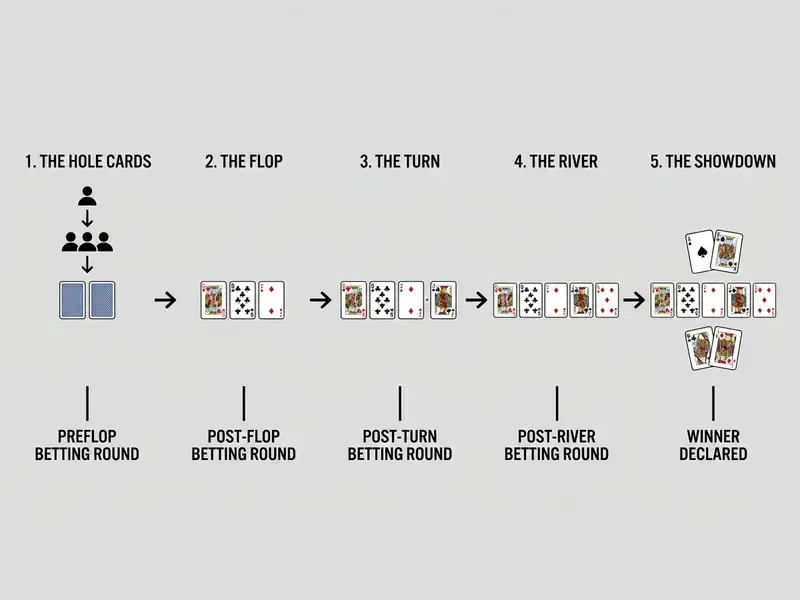
The Betting Structure: Four Streets

  1. Pre-flop. Each player receives two hole cards face down. The player left of the dealer button posts the small blind (half the minimum bet), the next posts the big blind (the full minimum bet). Blinds are posted before anyone sees a card. Available actions: fold, call, raise.
  2. Flop. The dealer burns a card and lays three community cards face up. A second betting round opens, starting from the first active player left of the button.
  3. Turn. A fourth community card is dealt. Third betting round.
  4. River. The fifth and final community card is dealt. Final betting round; all-in decisions are common here.
  5. Showdown. Remaining players reveal their hands. The best five-card combination out of seven available cards takes the pot. If everyone folds earlier, the last player standing wins without showing.
The Betting Structure Four Streets. 1

Betting Actions and Limit Structures

  • Bet opens the action with chips when no bet is outstanding.
  • Check declines to bet while keeping your hand.
  • Call matches the current bet.
  • Raise increases the current bet.
  • Fold surrenders the hand and all chips already committed.
Limit structureMaximum wager per streetTypical use
Fixed LimitPreset increment onlyStud, Limit Hold'em, low-variance grinders
Pot LimitUp to the current pot sizeOmaha (PLO, PLO5, PLO6)
No LimitUp to your entire stackHold'em cash games and MTTs

High-intensity betting structures deserve a caution. The association between fast, high-intensity gambling products and harm has been documented in broader gambling research.

«Simulated gambling products and loot boxes, which involve frequent bet-like actions, are associated with higher levels of monetary gambling harm.» Hing et al., "Simulated Gambling", Journal of Gambling Studies (2023). https://link.springer.com/journal/10899

Card Values and Hand Rankings

Hands rank by inverse probability: the rarer the combination, the stronger it is.

#HandDescriptionExample
1Royal FlushT-J-Q-K-A of one suitA♠ K♠ Q♠ J♠ T♠
2Straight FlushFive suited cards in sequence6♥ 5♥ 4♥ 3♥ 2♥
3Four of a KindFour cards of one rankQ♠ Q♥ Q♦ Q♣ + kicker
4Full HouseThree of a kind plus a pairJ-J-J-4-4
5FlushFive cards of one suitK♠ 9♠ 7♠ 5♠ 3♠
6StraightFive sequential cards, mixed suits6♣ 5♠ 4♦ 3♥ 2♣
7Three of a KindThree cards of one rank8-8-8 + two kickers
8Two PairTwo separate pairsK-K-A-A + kicker
9One PairOne pair9-9 + three kickers
10High CardNo combinationA-J-8-6-3 offsuit

Tie-breaks. Compare the rank of the made hand first, then kickers. Two players with the same pair compare their highest remaining side cards in order. If all five relevant cards match exactly, the pot is split equally; when a split cannot be made evenly, the odd chip is awarded according to house rules, usually to the player closest to the left of the button.

Academic work on real accounts helps validate how players actually behave, not just how they should. The "Second Session at the Virtual Poker Table" study in the Journal of Gambling Studies examines genuine online poker activity rather than recalled activity.

Tie-breaks. Compare the rank of the

«Account-based poker research reconstructs behaviour from hands played, bet sizes, and session outcomes rather than self-reported estimates.» Journal of Gambling Studies, "Second Session at the Virtual Poker Table" (2022). https://link.springer.com/journal/10899

No recent experimental study directly measures the impact of demo play on hand-ranking comprehension. The practical recommendation from training material is unchanged all the same: memorise the ten rankings before your first real-money hand. Misreading a board is the most expensive beginner error there is.

A Full Hand, Step by Step

  1. Button and blinds are assigned; small blind and big blind post automatically online.
  2. Two hole cards are dealt to each player.
  3. Pre-flop betting: action starts left of the big blind. Suppose blinds are $1/$2 and a player raises to $6; two callers make the pot $19 after the blinds fold.
  4. Flop 7♦ 2♠ 9♦: the first active player checks, the raiser bets $12, one caller. Pot $43.
  5. Turn 5♦: check, bet $30, call. Pot $103.
  6. River K♣: check-check. Pot stays $103.
  7. Showdown: A♦ 4♦ (flush) beats 9♠ 8♠ (three of a kind) and collects $103 minus rake.

Note the rake line at the end. That deduction is the operator's entire business model in peer-to-peer poker, and it is the number you should compare between poker sites far more carefully than any bonus percentage.

A Full Hand, Step by Step

Demo Poker, Free Play, and Simulated Gambling

In two sentences: Free poker is genuinely useful for learning the interface, the streets, and bet sizing without financial risk. It is a poor model of real opponents, because nobody at a play-money table is afraid of losing anything.

Definitions: Demo Games, Social Casino, and Simulated Gambling

Hing and colleagues define simulated gambling as games with features that resemble or function like commercial gambling activities.

«Simulated gambling covers loot boxes and simulated games: social casino products, demo games, and games with mini-gambling components, each with a different risk profile.» Hing et al., "Simulated Gambling Taxonomy", Journal of Gambling Studies (2023). https://link.springer.com/journal/10899

Poker demo lobbies sit inside that family. They use virtual chips, no cashier, and no verification step, which is precisely why they feel harmless and behave nothing like a real table.

What a Beginner Can Actually Practise in Demo Mode

  • Rules and flow:starting a hand, posting blinds, following the four streets, reaching showdown.
  • Interface handling:locating bet sliders, pot-size shortcut buttons, auto-muck settings, table info panels, and hand history.
  • Bet mechanics:sizing in big blinds rather than dollars, using percentage-of-pot presets, and watching how a raise reshapes the pot.
  • Action discipline:the difference between a free check and a lazy check, which is a habit worth building before money is on the line.
  • Multi-tabling ergonomics:tiling two or four tables before doing it with money at stake.
What a Beginner Can Actually Practise

Strategic and Psychological Limits of Free Poker

Because play-money chips have no value, opponents call far too wide, bluff recklessly, and ignore stack preservation. Hand-strength inference from betting patterns, the core skill of real poker, therefore barely transfers. Loss aversion, tilt control, and bankroll discipline cannot be rehearsed where there is nothing to lose.

An honest test: if you win eight buy-ins in a play-money session, ask whether you would have made the same river call for $40 of your own money. Usually the answer is no.

Order of First Play and Associations with Monetary Gambling Harm

One table in the Hing et al. study showed 49.9% lifetime engagement and 36.9% last-12-month participation for free social casino games.

«Lifetime engagement with free social casino games was 49.9%, last-12-month participation 36.9%, and mean age of first use 18.5 years.» Hing et al., "Order of First-Play in Simulated vs Monetary Gambling" (2023). https://link.springer.com/journal/10899

Implications for Poker Demo and Free Poker Play

Industry overviews emphasise that poker demo and free games are widely used by operators to attract new players and to shorten the path toward real-money play at online casinos. Treat demo mode as a flight simulator: excellent for controls, useless for weather. Move to the smallest real stakes as soon as you can read a board reliably, and set a deposit limit in CAD before your first session.

Disclaimer: This information is general in nature and does not replace professional advice. Online gambling carries financial risk; play responsibly and only on licensed platforms.

Real-Money Online Poker Sites: Licensing, Traffic, Comparison Matrix

In two sentences: The safety of a poker site is determined by its licence, its KYC/AML processes, its encryption, and its RNG certification, in that order. Everything else (bonus size, client design, freeroll count) is marketing.

Licensing and Regulatory Frameworks

Any operator providing online gambling facilities to consumers in Britain must hold appropriate licences from the UK Gambling Commission.

«A remote casino operating licence permits operators to offer poker, roulette, blackjack, and slots via websites, mobile apps, and television.» UK Gambling Commission, Remote Casino Operating Licence (2024). https://www.gamblingcommission.gov.uk

Regulatory standards also cover integrity. The UKGC's remote technical standards require operators to keep records, control game outcomes, and protect games against manipulation. The European Commission's 2024 anti-money-laundering package subjects online gambling operators to customer due diligence and transaction monitoring. FATF's 2024 guidance requires risk-based identification and verification of customers and beneficial owners, which is precisely why every legitimate room asks for documents before your first withdrawal. Canadian players hit the same wall through Ontario's registered operators and through FINTRAC-aligned processes at payment providers.

Unlicensed play is not a theoretical risk. Pennsylvania's assessment found that over 20% of online gamblers engaged in some form of illegal or unregulated online gambling, representing around 6% of the adult population.

Regulatory standards also cover integrity. The

«More than 20% of Pennsylvania's online gamblers used unlicensed sites, exposing themselves to non-payment of winnings and absence of data protection.» Pennsylvania Interactive Gaming Assessment (2024). https://gamingcontrolboard.pa.gov

Security checklist before depositing: named regulator and licence number visible in the footer and verifiable on the regulator's own register; TLS/HTTPS across the cashier; two-factor authentication available (NIST SP 800-63B recommends phishing-resistant MFA and rate limiting for higher assurance); published RNG or game-integrity testing by an independent laboratory such as GLI or eCOGRA; a clear complaints and dispute-resolution route with a named body, not just a support inbox.

Player Traffic, Game Choice, and Table Availability

Traffic dictates everything a strategy article cannot: how quickly a $0.05/$0.10 table fills, whether the 6-max PLO5 pool is beatable, and how many recreational players sit down on a Sunday evening. The UK Gambling Commission's remote GGY figures show the scale of the wider market.

«UK remote casino gross gambling yield reached GBP 4.4 billion in 2023 to 2024, of which GBP 3.6 billion came from slots.» UK Gambling Commission, Remote Gambling Statistics (2024). https://www.gamblingcommission.gov.uk/statistics-and-research/publication/remote-gambling-statistics

Practical rule: choose the room by pool softness and traffic at your stake, in your format, at the hours you actually play. Open the lobby at 8 p.m. Pacific on a Tuesday and count active tables. That two-minute check beats any review score, including this one.

Comparison Matrix: Real-Money Poker Rooms in 2026

Poker roomWelcome bonusRakebackNetworkMin. deposit / payout speedCryptoSignature feature
CoinPoker150% up to $2,000 + $50 (1x wagering)CoinRewards, up to ~33% effectiveIndependentPayouts processed every ~2 hoursYes (USDT, CHP)$7M monthly rewards, $3,000 GTD monthly freeroll, Short Deck and PLO6
ACR Poker100% up to $2,00027% flat or VIP loyaltyWinning Poker NetworkSame-day crypto withdrawalsYes (BTC, LTC)Venom series paying $20M+ per year; $9.2M weekly MTT guarantees
Stake.us Poker250,000 Gold Coins + 25 Stake Cash5% VIPIndependentNear-instant crypto cashoutYesSoftest pools (casino crossover traffic), Run It Twice, straddles
Ignition Poker300% up to $3,000Loyalty rewardsPaiWangLuoCrypto usually under 1 hourYesAnonymous tables plus Zone fast-fold
Bovada100% up to $500Loyalty rewardsPaiWangLuoCrypto usually under 1 hourYesFirst US room to launch fast-fold (Zone Poker, 2013)
BetOnline100% up to $1,000 + tournament tickets25%Chico Poker Network1 to 3 days fiat, faster cryptoYesShort Deck plus sportsbook and casino in one wallet
Jack Poker300% up to $2,000 + 20% instant cash10%IndependentFast cryptoYesBad Beat Jackpot and mission-based rewards
bet365 (Live tables)100% matchReduced rake 3% to 5%Proprietary1 to 3 days (fiat)No12 live poker tables per hour, 1080p/60fps streams
FanDuel CasinoState-specific offerCasino loyaltyProprietary1 to 3 days (fiat)NoFully regulated US live dealer tables (NJ, PA, MI, WV)
888casino100% matchRake 5%, drops to 3% over $100 buy-inProprietary / Evolution live1 to 5 days (fiat)NoUKGC-licensed live poker, blackjack, baccarat

Verification note for Canadian readers: bonus values, rakeback tiers and payout windows change without notice, and provincial availability differs. Confirm each figure on the operator's own terms page and on the regulator's register on the day you sign up. Where a room's Ontario status could not be verified at the time of writing, treat it as: no data.

Case in point: CoinPoker hosted what the industry recorded as the biggest cash-game pot in online poker history. Co-owner Tony G won over $7.7 million in a single hand at $5,000/$10,000 PLO after flopping the nuts. A useful reminder that headline liquidity and headline variance live at the same address.

Verification note for Canadian readers bonus

Bonuses, Payment Methods, and Cash-Out Conditions

Payment rails now split cleanly into three groups. Cards and bank transfers are slow, reversible, and widely accepted in regulated markets. E-wallets, including Interac e-Transfer for Canadian accounts, clear faster but are sometimes excluded from bonus eligibility. Crypto is quickest of all, with no chargebacks, more volatility, and an FX cost when your balance is in CAD.

Given the absence of a single standard for bonus terms, the most evidence-based recommendation is dull but correct: read the terms line by line, and prefer licensed casinos with transparent terms over the biggest advertised percentage.

Always confirm, in writing, before depositing:

  • bonus amount and match percentage;
  • wagering requirement multiplier, and whether it applies to bonus only or deposit plus bonus;
  • game weighting (poker and live dealer tables are frequently weighted at 10% to 50%);
  • rake-based release schedule, since many poker bonuses release in increments per rake generated;
  • expiry window;
  • maximum cashout and maximum bet while a bonus is active;
  • withdrawal fees, minimum withdrawal amount, and whether CAD is held natively or converted.
Bonuses, Payment Methods, and Cash-Out Conditions

The Cold Math: Bonuses, Wagering, Rake, and RTP

In two sentences: A bonus is a turnover requirement dressed as a gift. Once you multiply the playthrough by the game weighting and subtract the house edge or rake you pay along the way, most "free money" is net negative.

Formula 1: effective bonus value

A room offers a 100% match on a $10 deposit, with 30x playthrough, and counts live poker at 50% weighting:

Required turnover = ($10 × 30) ÷ 0.50 = $600

At an average house edge of 2.5% on the qualifying games, expected loss on the way to clearing is:

$600 × 0.025 = $15

You risk $15 of expected value to unlock $10 of bonus. Net expectation: negative $5. The arithmetic behaves the same in CAD, and competitor claims that a $10 gift becomes "a $5 effective boost" are consistent with this calculation. That is the optimistic reading, incidentally, because it ignores the FX spread and the temptation to raise stakes to finish on time.

Formula 1 effective bonus value. A

Formula 2: loyalty and birthday offers

Operators typically allocate around a 0.2% marketing budget per player, which means a "$20 free" birthday bonus is worth roughly $0.04 in expected value once wagering requirements and house edge are applied. Treat these as retention nudges, not income. Figure reported by operators; independent verification is limited.

Formula 3: rake and the real return-to-player

  • Standard cash-game rake is 5% of the pot, capped per hand.
  • Some operators (888casino, for example) reduce it to 3% on live dealer tables when the buy-in exceeds $100. The reduction activates only after the first 20 hands, which is precisely the window in which a new player is still learning the interface.
  • Industry estimates put a four-camera HD studio installation in the region of $12,000, and that overhead reaches players through higher minimum bets: roughly $5 at live tables versus $2 at RNG tables.
  • Combined effect: a nominal RTP near 96.1% at a virtual table is diluted by dealer commission and higher rake to roughly 94.8% at a live dealer table.

Rakeback is the only reliable "bonus". A flat 27% rakeback (ACR) or an effective 50% to 65% return through leaderboards and rewards (CoinPoker's CoinRewards, BCPoker) reduces your cost per hand every single session, with no playthrough attached. No expiry, no maximum cashout, no weighting table. If you compare two rooms on one number only, compare that one.

Formula 3 rake and the real

Getting Started: Registration, KYC, First Table, Offer Checklist

In two sentences: Onboarding is four steps, namely register, verify, deposit, sit down, and the only step that regularly goes wrong is verification. Prepare documents before you deposit, not after you win.

Registration and Initial Game Selection

85% of new online poker users now sign up via smartphones, according to H2 Gambling Capital's 2023 analysis (Track360, https://track360.com/online-gambling-statistics). The sequence is consistent across licensed rooms:

  1. Create the profile. Use your legal name exactly as it appears on your ID. Mismatches are the number-one cause of frozen withdrawals, and I have seen a single missing middle initial hold a payout for eleven days.
  2. Enable 2FA immediately, before the first deposit.
  3. Pass KYC. Expect a government ID, a proof of address dated within three months, and a screenshot of the payment method. Crypto-first rooms may defer verification until a withdrawal threshold is crossed, which delays the friction rather than removing it.
  4. Confirm geolocation. In regulated US states and in Ontario, a geolocation check must confirm you are physically inside the licensed territory.
  5. Choose the first table. Start at the lowest cash stake available ($0.01/$0.02 to $0.05/$0.10) or a $1 to $5 Sit & Go. Six-max rather than full-ring, one table only.
  6. Set limits before the first hand: deposit limit, session time limit, and loss limit.
Registration and Initial Game Selection. 85

Evaluating Bonus Offers Before Activation

Decline any bonus you cannot clear at your natural playing volume. Chasing playthrough forces higher stakes and longer sessions, the exact pattern associated with elevated risk. Prevalence studies linking mixed-mode gambling, both in-person and online, to higher problem gambling risk are relevant here.

«Gamblers who combine online and land-based play show the highest problem gambling risk; exclusively land-based gamblers show the lowest.» Pennsylvania Interactive Gaming Assessment (2024). https://gamingcontrolboard.pa.gov

A quick two-minute test on any offer: divide the required turnover by the hands you realistically play per week. If clearing it takes more than a month at your normal stake, the bonus is not for you. Skip it and take rakeback instead.

Pre-Deposit Checklist

  • Regulator name and licence number verified on the regulator's own register
  • HTTPS cashier, 2FA enabled, unique password
  • Independent RNG or game-integrity testing published
  • Withdrawal method available in your province or country, with a stated processing time
  • Currency handling checked: CAD balance, or the FX cost of converting
  • Bonus terms read: multiplier, weighting, expiry, max cashout, max bet
  • Rakeback or loyalty scheme understood in percentage terms
  • Traffic checked at your stake and format at the hours you actually play
  • Deposit, loss, and session limits set
  • Self-exclusion and support contacts noted
Pre-Deposit Checklist. - Regulator name and

Live Dealer Poker and Live Casino

In two sentences: Poker live dealer tables stream a human dealer from a studio, usually in house-banked variants such as Casino Hold'em or Three Card Poker. Poker live casino buys atmosphere at the cost of speed, higher minimums, and a measurably lower effective RTP.

Mechanics of Live Dealer Poker Tables

A live table combines four technical layers: multi-camera HD video (typically 1080p at 60fps), RFID-tagged cards that let the system read each card and reconcile it with the video feed, a text chat channel to the dealer, and a human host who announces bets, deals, resolves the round, and keeps table rhythm. bet365's live poker lobby, for instance, hosts around 12 tables at any given hour, each with a maximum of eight seats. Compare that with a 30-minute seat wait at a busy land-based room on a Friday night.

MarketIntelo cites live streaming integration as generating 18% viewer-to-player conversion rates across platforms with more than 500 million combined monthly views, which explains why every major operator now treats the live studio as an acquisition channel rather than a game.

Mechanics of Live Dealer Poker Tables

Where Regulation Puts Live Poker

Under the UKGC's remote technical standards (2023), live-dealer content sits inside remote gaming controls rather than a separate card-game standard, so oversight shifts from RNG certification to studio procedure, camera coverage, and table supervision. The European Commission's 2024 AML package applies customer due diligence to these tables even though play feels physical. In Ontario, live studio content served to provincial players falls under the same registered-supplier requirements as the rest of an operator's catalogue.

When to Choose Live Poker Versus Standard Online Poker

CriterionLive dealer tableStandard online poker
Hands per hour~30 to 5060 to 100 per table
Minimum bet~$5~$2
Effective RTP~94.8%~96.1% nominal
OpponentUsually the houseOther players
Social factorDealer interaction, chat, table talkChat-limited, often anonymous
Long-run profitabilityNot achievableAchievable with a skill edge
Multi-tablingNoYes

Remote gambling statistics show how much money moves through this category:

«UK remote casino generated GBP 6.9 billion in gross gambling yield in 2023 to 2024, up 6.9% year on year and 20.3% above pre-pandemic levels.» UK Gambling Commission, Remote Gambling Statistics (2024). https://www.gamblingcommission.gov.uk/statistics-and-research/publication/remote-gambling-statistics

Verdict: choose live tables for entertainment and pace, choose peer-to-peer poker if your goal is a long-run edge. Both can sit in the same account. Only one of them can be beaten.

Practical Timing and Psychology Hacks for Live Tables

These four adjustments come from operator-reported table data and practitioner observation rather than peer-reviewed research. Treat the percentages as directional, not certified.

  1. Use the 60-second auto-cashout window. If the platform lets you set a 60-second auto-withdrawal, lock in a confirmed win (for example +$15 on a $2.50 average pot) before the next shuffle. It freezes variance and, per operator data, prevents a swing that erases roughly a third of a modest profit.
  2. Leave before the dealer break. Most studios enforce a 10-minute dealer break after every 150 hands. The reshuffle and dealer change reset table dynamics, and mid-tier Canadian operator data reports an average 7% dip in player win rate immediately after. End the session around hand 145.
  3. Respect the 8-second rule. On most live tables the first post-flop decision lands within 8 seconds. Making decisions in a consistent sub-7.5-second window denies opponents timing tells through the chat and keeps your ranges harder to read.
  4. Ignore the friendly dealer. According to observational analysis of 1,200 hands, players who received a complimentary remark from the dealer increased their subsequent wagers by roughly 12%, shaving about $0.30 per hand off expected value. Charm is part of the product. Price it accordingly.
9. Practical Timing and Psychology Hacks

Poker Strategy, Player Behaviour, and Problem Gambling Risk

In two sentences: Poker is the only casino-adjacent product where a small minority achieves a genuine long-run edge. For everyone else, structure and discipline matter far more than any single tactic.

Fundamentals for Beginners

  • Position. Acting later means acting with more information. Play more hands from the button and cutoff, far fewer from the blinds.
  • Starting-hand selection. Use a chart. Fold roughly 75% to 80% of hands pre-flop at full ring.
  • Pot odds and equity. Compare the price of a call with your chance of winning. Calling $25 into a $100 pot needs about 20% equity to break even.
  • Bet sizing. Size in fractions of the pot (33%, 66%, 100%) rather than round dollar amounts.
  • Bankroll. Minimum 30 to 50 buy-ins for cash games, 100 or more for MTTs.

Typical beginner errors: playing too many hands, ignoring position, calling out of curiosity, chasing losses by moving up in stakes, and refusing to fold a hand they "already invested in". That last one has a name in behavioural economics, the sunk-cost fallacy, and it costs recreational players more than any missed bluff.

Fundamentals for Beginners. - Position. Acting

How to Read a Hand and the Other Players

Poker strategy is mostly narrowing ranges. Ask three questions on every street: what would this opponent bet with, what would they check with, and does the current bet size fit either story? A player who calls pre-flop, checks the flop, then leads big on a turn flush card is rarely representing nothing.

Track two simple stats if your room allows a HUD: how often an opponent enters a pot, and how often they raise. Loose-passive players get value bet. Tight-aggressive players get folded to. Everything else is refinement.

Bluffing Concepts Worth Learning Early

  • Backdoor flush bluff. A backdoor flush needs suited cards on both the turn and the river. Because the runout looks credible, semi-bluffing with backdoor equity carries weight, and sometimes you genuinely get there.
  • Check-raise after the flop. Checking to induce a bet, then raising, builds a pot with initiative and puts marginal hands under pressure in a spot where nobody has a strong range yet.
  • Suited connectors. Two suited cards close in rank (J♣ 9♣, for example) can turn into straights, flushes, and straight flushes. They are implied-odds hands, not showdown hands, so play them for position and pot potential rather than pride.
Bluffing Concepts Worth Learning Early

Elite Professional Online Poker Players

Newall and Talberg's 2023 study examines elite professional online poker players and the size of the winning minority.

«Poker is unique among casino products: highly skilled players can achieve a consistently positive expected value, while the majority of participants lose money.» Newall & Talberg, "Elite Online Poker Players", Addiction Research & Theory (2023). https://www.tandfonline.com/journals/iart20

Behavioural Markers of Harm

Rather than asserting broadly that free social casino games "precede" monetary gambling, stick to the measured figures reported by Hing et al. (2023): 49.9% lifetime engagement, 36.9% past-12-month participation, mean age of first use 18.5 years. Those establish high youth exposure and early onset, while the direction of causality remains an open research question.

High frequency of play, long sessions, and mixed-mode participation are the markers most consistently associated with harm across the regulator and academic sources cited here. Pennsylvania's assessments put the point plainly.

«Mixed gamblers (online plus land-based) show the highest problem gambling risk; exclusively land-based gamblers the lowest.» Pennsylvania Interactive Gaming Assessment (2024). https://gamingcontrolboard.pa.gov

If two or more of those markers describe your last month, the useful move is a cooling-off period, not a better strategy chart.

Mobile Access and Device Compatibility

In two sentences: In 2026 most poker is played on a phone, through either a native app or a browser client. What limits access is not hardware but app-store policy and jurisdictional licensing.

Mobile Poker Availability and User Experience

MarketIntelo indicates that mobile applications account for 54.2% of platform revenue as of 2026, rising to 62.1% by 2034, while desktop declines to 26.4% and tablets to 11.5%. Practical consequences:

  • Native iOS and Android clients typically allow up to four simultaneous tables; browser clients often fewer.
  • Instant-play browser rooms (CoinPoker, for example) remove installation friction entirely, useful where app stores restrict real-money gambling apps.
  • Tablets share the account stack with phones but render multi-table layouts closer to desktop.
  • Network stability matters more than raw device power. A dropped connection during an all-in is resolved by the room's disconnect protection policy, which you should read once, in advance, not mid-hand on a train.
Mobile Poker Availability and User Experience

Technical and Regulatory Considerations for Mobile Poker

US state regulators typically require geolocation checks to confirm that players are within state borders, and Ontario applies an equivalent provincial check.

«US regulators require geolocation verification confirming the player is physically within state boundaries before real-money play is permitted.» Pennsylvania Gaming Control Board, iGaming Regulations (2024). https://gamingcontrolboard.pa.gov

Because a phone is always present and always available, responsible gambling measures tailored to mobile use carry extra weight. App-level session reminders, notification controls, and responsible gambling tools on mobile platforms such as cooling-off periods and self-exclusion should be configured on day one, while you are calm and not chasing anything.

Where You Can Play Legally: Regulation and Licences in 2026

  • Canada. Gambling is regulated provincially. Ontario runs the fullest framework through iGaming Ontario and the AGCO, with registered operators, local dispute resolution, and mandatory responsible-gambling tools; provincial lottery corporations (OLG, BCLC PlayNow, Loto-Québec, ALC) operate their own platforms elsewhere. Many international rooms accept Canadian players, some under a Kahnawake Gaming Commission certificate. Minimum age is 19+ in most provinces and 18+ in Alberta, Manitoba and Quebec. Verify provincial availability, CAD support and Interac e-Transfer options before depositing.
  • United States. Regulated real-money online poker and casino play is available in New Jersey, Pennsylvania, Michigan and West Virginia. Leading regulated operators include FanDuel Casino, PokerStars and bet365. Geolocation and state-level KYC are mandatory.
  • United Kingdom. Strictly regulated by the UK Gambling Commission, which requires a remote casino operating licence for poker, roulette, blackjack and slots delivered via websites, apps or television. Market leaders include 888casino and PartyCasino.
  • Europe and global markets. Look for a Malta Gaming Authority licence, or, for crypto-first rooms such as CoinPoker and Stake, offshore licensing from Curaçao or Anjouan. Offshore licences offer weaker dispute resolution than the UKGC or MGA. Weigh that against faster payouts, honestly.

Red flags in any jurisdiction: no named regulator, no licence number, no published payout timeframes, bonus terms that change after registration, and support that answers only by email. Any two of those together, and the withdrawal is the part that will hurt.

12. Where You Can Play Legally

FAQ: Rules, Bonuses, Mobile Play and Payouts

Conclusion

Online poker in 2026 rewards preparation over enthusiasm. Learn the four streets and the ten hand rankings before you deposit. Use demo tables for the interface and nothing else. Choose a room by licence, traffic and rakeback rather than by the size of its banner, and treat every bonus as a turnover obligation until the arithmetic proves otherwise. Market analyses consistently show a large and growing global market behind all of this.

«The online poker market is set to grow from USD 3.84 to 3.86 billion in 2024 to 2025 to USD 6.9 to 7.45 billion by 2030 to 2031, at a CAGR of 10.2% to 11.65%.» Grand View Research / Mordor Intelligence, Online Poker Market Reports (2025). https://www.mordorintelligence.com/industry-reports/online-poker-market

Live dealer tables are worth trying once for the atmosphere: the streamed studio, the RFID-verified deal, the dealer who knows your screen name. Just remember what the numbers say. Minimum bets roughly double, rake reductions arrive only after the first 20 hands, and effective RTP settles near 94.8% instead of 96.1%. That is the price of the show.

Peer-to-peer tables, by contrast, are the only place where skill compounds. It is exactly why the strongest players spend their volume there, and why the softest pools, casino-crossover traffic at Stake.us or low-stakes MTTs at ACR, stay the best value on the board.

Compare on the facts, read the terms before you deposit, and play within a limit you set in advance. 19+ in most provinces, 18+ in Alberta, Manitoba and Quebec.

Live dealer tables are worth trying

Disclaimer: This information is general in nature and does not replace professional advice. Online gambling carries financial risk and all stakes can be lost. Participation is restricted to adults (18+, 19+ or 21+ depending on jurisdiction). Play responsibly, use self-exclusion and limit-setting tools, and choose only licensed platforms. If gambling stops being entertainment, contact a national or provincial gambling support service, such as ConnexOntario in Ontario or your provincial helpline.