Mines Game: Free Demo Play, Real Odds and Strategy Guide for Canadian Players

Last updated: January 2026 · Reviewed by Reid Calloway, Independent Online-Casino Analyst (Vancouver, BC) · 19+ content

The 30-second version

  • What it is: a grid-based instant-win game (Spribe, Hacksaw Gaming, Turbo Games) inspired by Minesweeper. Open safe tiles, grow the multiplier, cash out before a mine.
  • Grid: 5×5 (25 tiles) is the standard; Hacksaw also offers 3×3, 7×7 and 9×9.
  • RTP: 98.00% at Spribe and Hacksaw Gaming, 95.00% at Turbo Games, so a house edge of 2% to 5%.
  • Stakes: from $0.10 to $0.20 CAD; maximum bet from $150 CAD (Spribe) to $1,000 CAD (Hacksaw).
  • Max win: up to 10,000x (Hacksaw, Turbo Games) and a theoretical 500,000x cap on Spribe's version.
  • Free demo: available with virtual credits, no deposit and usually no registration.
  • Best for: short sessions with pre-set cash-out targets. No betting system removes the house edge.

Mines is a grid-based, multiplier online casino game inspired by the classic minesweeper puzzle, where players open safe tiles to increase their cash-out value before hitting a hidden mine. The core objective is simple: navigate a 5×5 field, build your payout multiplier with every safe reveal, and cash out before triggering an explosion.

«The review process is designed to test sign-up, deposit and cash-out before scoring. Mines looks simple on the surface, but understanding how grid density, payout curves and house edge interact is critical before you wager a single dollar of your bankroll.» Reid Calloway, Independent Online-Casino Analyst (Vancouver, BC).
Provider

Spribe / Hacksaw Gaming / Turbo Games

RTP

98.00%

Volatility

High

Min bet

$0.10 CAD

Max bet

$150 CAD

Max win

10,000x

Mines Game Free Demo Play, Real

Why this matters if you play from Canada

Most Canadians meet Mines in a casino lobby, not in a maths textbook. The question behind the search is usually narrower than «how does it work»: can I try it free, will the site actually pay me in CAD, and is the bonus worth taking?

Three points shape the answer here. First, legality is provincial. Ontario players sit under iGaming Ontario and the AGCO; other provinces are served largely by offshore-facing brands with Kahnawà:ke, Malta or Curaçao licences. Second, payment rails matter more than logos: Interac e-Transfer keeps everything in Canadian dollars and usually clears an approved withdrawal inside a couple of hours. Third, instant-win titles like Mines are the games most often capped in bonus contribution tables, which quietly changes what a welcome bonus is worth to you.

So we will move in that order: mechanics, then math, then the money, then the risks. And yes, you can test the whole thing for free first.

Why this matters if you play

What Mines Game is and how the game works

Mines is an instant-win casino gambling game built on a randomized grid where every safe cell increases your cash-out multiplier, while a single mine ends the round instantly and forfeits your stake. Operating on a pseudo-random number generator (RNG) or a Provably Fair hashing system, the game puts full control of round duration and cash-out timing directly in the player's hands.

Mathematically, Mines belongs to the same family as crash titles: the multiplier keeps climbing until a random event terminates the round and takes the stake with it.

«Mines-type products share the crash-game structure: an escalating multiplier interrupted by a random terminating event.» Scott & Sher, Cash or Crash, Gaming Research & Review Journal (2023–2024).

The game sits in the same modern casino category as crash games and high-volatility interactive online slots. While slot reels run on fixed spin outcomes, Mines lets you choose when to stop after every successful step. Here is the catch, though: every safe cell revealed leaves fewer safe tiles on the field, which raises the mathematical risk of hitting a mine on your next pick.

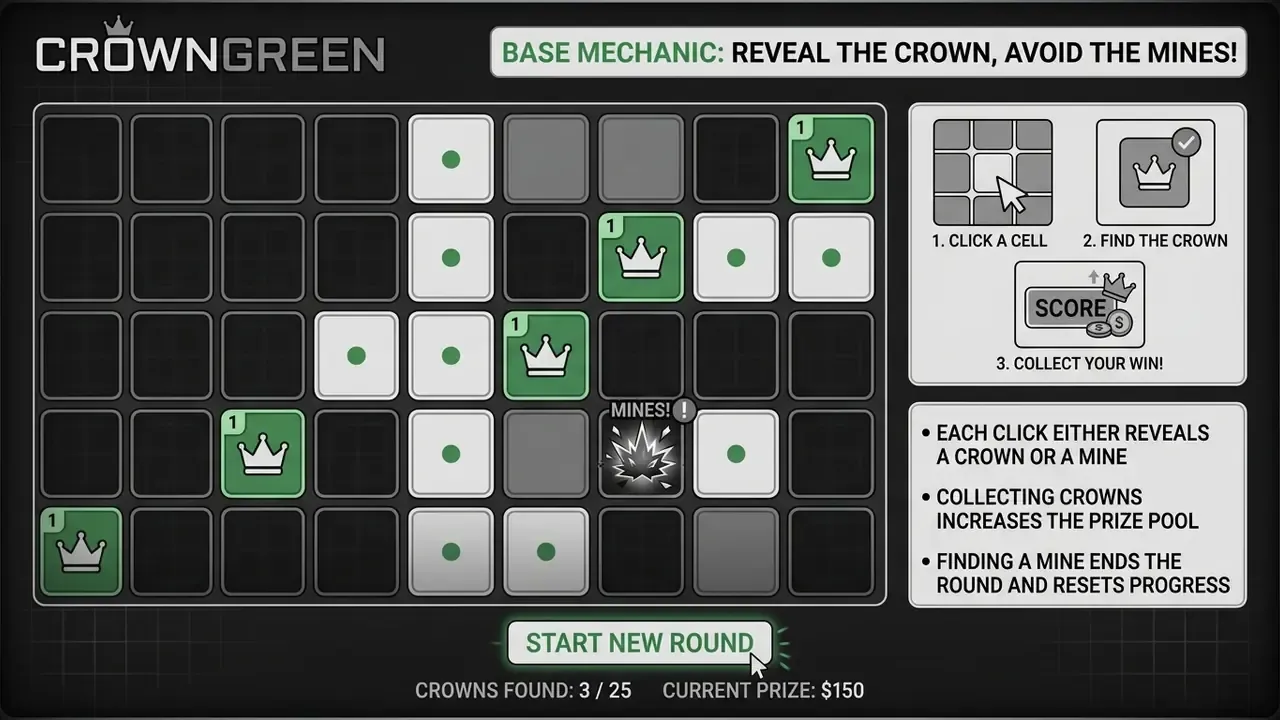
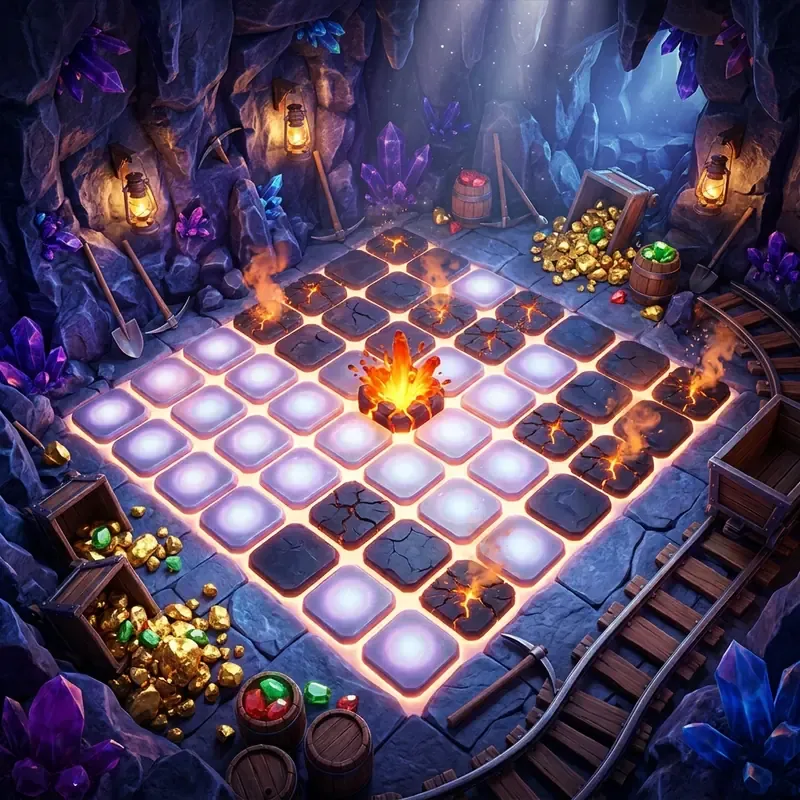
Caption: Visual schema of a 5×5 Mines game grid showing safe cell reveals, multiplier progression, hidden mine locations and the cash-out button.

«Mines» is not a single game but a game format released by several studios. Before you deposit, check the provider badge in the game info panel, because RTP, bet caps, maximum exposure and even the grid geometry differ between versions.

Practical takeaway: the three-percentage-point gap between a 98% and a 95% version equals a house edge of 2% versus 5%. In plain terms, the Turbo Games build costs roughly two and a half times more per dollar wagered over the long run. Hacksaw's version certifies its 98% RTP over ten billion simulated rounds and exposes a Provably Fair verification panel, while Spribe pairs the same 98% figure with a much lower maximum bet of $150 CAD.

The playing grid, mines and safe tiles

The standard Mines game field consists of a 5×5 grid containing 25 concealed tiles. Before starting a round, the player selects the total number of hidden mines, typically anywhere from 1 to 24, which directly sets the difficulty and the starting multiplier value. On Hacksaw Gaming's build you can also switch the geometry to 3×3, 7×7 or 9×9. Bigger boards pay less per individual gem but lower the per-click probability of an explosion, which changes the entire risk curve rather than just the payout size.

Selecting fewer mines (say 1 to 3) creates a grid dominated by safe cells, shown as stars or crystals, offering high survival odds per pick but modest multiplier growth. Set 10 or 15 mines instead and the number of safe tiles drops sharply, creating a high-volatility environment where each successful click delivers a much bigger bump in the winnings you can lock in.

Formally, the chance of clearing t tiles in a row without an explosion follows a hypergeometric expression rather than a simple percentage:

$$P(t\ \text{safe picks}) = \frac{\binom{N-M}{t}}{\binom{N}{t}}$$

where N is the number of cells on the board and M is the number of mines.

The playing grid, mines and safe

«Sampling without replacement makes each successive survival less likely; the round's survival probability is a shrinking product of conditional odds.» UChicago REU, Martingales in Gambling and Finance (2023).

Multiplier and cashing out winnings in Mines

The payout multiplier in Mines expands continuously with every consecutive safe tile opened during an active round. Cash-out lets you lock in the displayed multiplier at any moment, settling the round and moving the winnings to your balance.

The exact multiplier sequence is predetermined by the game's odds table, based on grid size and total mine count. Open 3 safe cells on a 3-mine grid and your potential cash-out might reach 1.45x your stake; open those same 3 cells on a 10-mine grid and it might pass 4.50x. Hit a mine before pressing cash out, though, and the round terminates immediately with the stake gone.

Because the multiplier comes from the odds table and not from skill, the payout you see is simply the inverse of the survival probability multiplied by the game's RTP: multiplier ≈ RTP ÷ P(t safe picks). That single line explains why bigger multipliers always arrive attached to smaller survival odds.

Multiplier and cashing out winnings in

How to play Mines: rules and order of actions

Starting a round in Mines online requires setting your bet amount, selecting your preferred mine count, opening tiles on the grid, and executing a cash-out before a mine is revealed. The game flow is completely turn-based, so no timer forces your next pick.

Step-by-step checklist for playing Mines

1
Set bet amount. Enter your chosen stake in CAD, making sure it fits the session bankroll limit you planned before opening the game.
2
Configure mine count. Select between 1 and 24 mines on the 5×5 grid to establish your target risk and volatility level.
3
Choose the grid size (where offered). 3×3 for very short sessions, 7×7 or 9×9 for longer, lower-risk trajectories.
4
Start the round. Click the primary bet button to lock in your stake and initialize the randomized grid layout.
5
Select grid tiles. Click individual tiles to reveal safe symbols (crystals or stars) or a mine.
6
Evaluate the multiplier. Watch the updated cash-out value after each safe pick and weigh reward against remaining risk.
7
Execute cash out. Press the cash-out button to claim your accumulated winnings before hitting a mine.

Choosing your bet and the number of mines

Setting your bet amount and mine count is the foundational step that determines variance and the shape of your maximum payout curve. Most casino platforms allow bets from minimal stakes of $0.10 CAD up to operational max bet caps of $100 to $500 CAD depending on provider rules, with Hacksaw's build stretching as high as $1,000 CAD per round.

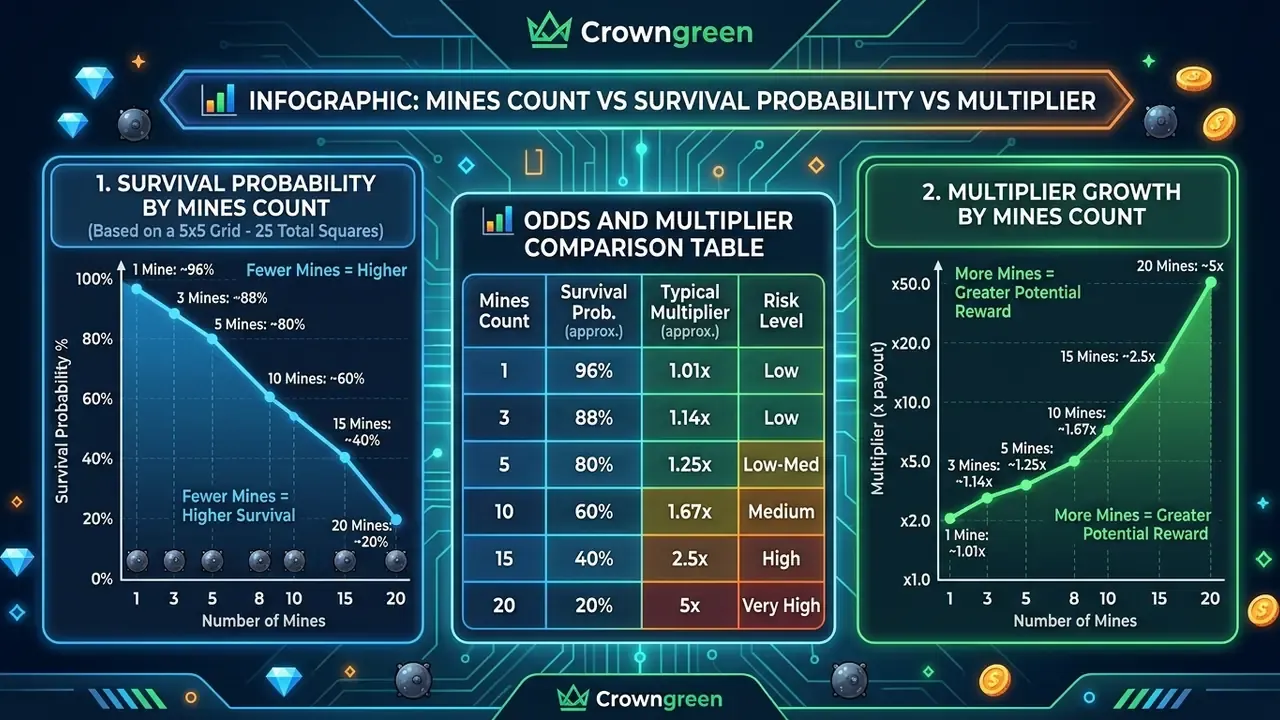
The mine selector changes the probability distribution of the board instantly. A low mine count (1 to 2 mines) means 92% to 96% of the grid is safe on click one, which suits lower-variance play. Raise the mine count to 10 or more and the game moves into high-volatility territory, where a single click carries a 40% or higher chance of ending the round on the spot.

Where those percentages come from (verification note). On a 25-tile board the chance of hitting a mine on the first click is simply M ÷ N. With 1 mine that is 1/25 = 4% (96% safe); with 2 mines, 2/25 = 8% (92% safe), hence the 92% to 96% range. With 10 mines it is 10/25 = 40%, and every additional mine pushes that failure rate higher. These figures are arithmetic consequences of the grid, not editorial estimates; the same hypergeometric logic documented by the UChicago REU (2023) governs each subsequent pick.

Choosing your bet and the number

When to cash out

Knowing when to cash out is the central decision point in Mines. You are balancing a multiplier target against probability decay, nothing more. Crash-game research indicates that most bets are closed at low multipliers rather than in pursuit of jackpot-scale payouts.

«Most crash-game wagers were cashed out at multipliers around 2x or lower, rather than chasing maximum payouts.» Scott & Sher, Cash or Crash, Gaming Research & Review Journal (2023–2024).

The fine print of the game math shows survival probability dropping with every open cell. On a 5-mine grid your chance of surviving click one is 80% (20/25). By click four, your survival chance on that specific step falls to 70.5% (17/22). Cashing out early protects accrued gains from this compounding risk curve. Not glamorous. Effective.

Extra features: autoplay, auto-cashout, turbo mode and selectable grids

  • Auto-cashout. Lets you pre-set a target multiplier, for example 1.50x, at which the game collects the win automatically, removing in-round emotion from the decision. Spribe's help panel describes it as configuring auto-cashout at predetermined multiplier levels.
  • Autoplay (auto-bet). Repeats the same stake, mine count and tile pattern for a set number of rounds. Useful for testing a hypothesis in demo mode, risky with real funds because it removes the natural pause between decisions.
  • Turbo mode. Speeds up reveal animations for rapid-fire sessions. Rounds typically last 5 to 30 seconds even without turbo, so this feature mainly increases the number of bets per hour, and bet frequency is the single biggest driver of long-run cost.
  • Grid resizing (Hacksaw). 3×3 boards suit very short sessions; 7×7 and 9×9 boards spread the same mine count over more tiles, lowering starting risk per click while shrinking each individual multiplier step.
  • Session controls. Look for bet-amount limits, daily, weekly and monthly loss limits, session-duration reminders and cool-off periods from 24 hours to 30 days in your account dashboard. Auto-cashout doubles as a safety mechanism, since it defines your exit point before the round begins.
Extra features autoplay, auto-cashout, turbo mode

Mines demo and free play: how to play for free

Mines demo is a risk-free practice mode that uses virtual credits to mirror the exact grid mechanics, mine selectors and multiplier tables of real-money play. It lets you test interface responsiveness, cash-out timing and bet configuration options without depositing funds.

Free mines access is widely supported across online casino lobbies and software provider sites. Demo credits have no cash value and cannot be withdrawn as real winnings, but the mode gives you a safe environment to observe how different mine densities change round outcomes. Most demo builds load in the browser within a few seconds, require no registration and no personal data, and support full-screen play on desktop and mobile.

Mines demo and free play how

What you can test in Mines demo

The demo version allows full exploration of game mechanics, grid tile selections, stake adjustments and cash-out execution. You can simulate different staking hypotheses, such as comparing a 3-mine board with a 12-mine board across 50 simulated rounds, without financial loss.

Through free play you can also inspect the interface layout on desktop and mobile browsers, verify how fast multipliers update after each pick, and get comfortable with manual versus automated picking where available. Demo is the safest place to rehearse a Provably Fair verification too: open the fairness panel, copy the round hash and confirm the seeds before you ever risk CAD.

What demo cannot test is bankroll risk. Simulated variance is not financial variance, and a virtual balance never triggers loss aversion.

What you can test in Mines

How demo differs from real-money play

Mines demo uses identical RNG algorithms and payout math as real-money modes, yet it completely lacks the psychological pressure that arrives with real stakes. Free play is also the industry's main acquisition funnel, not a neutral training ground.

«Roughly 65% of new online slot players use demo mode before their first real-money wager, making demo a key acquisition touchpoint.» The Evolving Role of Demo Versions in Slot Game Development, Ball State University (2023).

«Participants kept wagering in the app even after rewards were removed, so behaviour learned in simulated play persisted.» James et al., Gambling on Smartphones (2019).

In demo mode, losing virtual credits creates zero financial impact, which nudges players into aggressive picks they would avoid with cash. When real money is on the line, emotional responses to losses can trigger loss-chasing behaviour. Demo play is an educational tool for learning the rules; it is not a proofing ground for «guaranteed» winning strategies. Wider literature on simulated gambling points the same way: free-play exposure can inflate risk tolerance and desensitise players to monetary loss before the first deposit.

RTP, risk and win potential in Mines

Return to Player (RTP) in Mines depends on the provider build rather than on a single industry figure. Spribe and Hacksaw Gaming both publish 98.00%, while Turbo Games' version is documented at 95.00%. RTP represents the theoretical long-term percentage of wagered money returned to players over millions of rounds; session-level volatility causes actual short-term results to deviate significantly from that benchmark. In practice, expect a house edge of 2% on the highest-RTP builds and 5% on the lowest.

Official RTP figures on regulated iGaming platforms represent administrative long-term averages across all wagers, not a guarantee of payout for any single gaming session.

RTP, risk and win potential in

«The average RTP of regulated online slots in Pennsylvania is roughly 96%; individual sessions can deviate substantially from that value.» Sterner et al., Pennsylvania Online Gambling Report (2023).

How the number of mines affects risk and multiplier

Adjusting the number of mines on the 5×5 grid recalibrates both the payout curve and the probability of hitting a mine on every selection. The formula for surviving a single pick on a grid with $N$ cells and $M$ mines is:

$$P(\text{safe}) = \frac{N - M}{N}$$

Plain-language example. On a 25-cell board with 5 mines, $N = 25$ and $M = 5$, so $P(\text{safe}) = (25 - 5) \div 25 = 0.80$: an 80% chance your first click is safe and a 20% chance the round ends immediately.

For a 25-cell grid with 1 mine, your first pick has a 96% (24/25) survival chance, which yields a low starting multiplier of roughly 1.01x to 1.03x. With 10 mines, first-pick survival drops to 60% (15/25), but the initial multiplier jumps to about 1.55x. Same board, very different game.

How the number of mines affects

Mines payout matrix: multipliers and survival odds side by side

Approximate cash-out multipliers on a 5×5 grid at 98% RTP, with the probability of reaching that step shown in brackets. Exact tables vary slightly by provider.

Mines1 tile opened2 tiles opened3 tiles opened5 tiles opened
11.02x (96.0%)1.06x (92.0%)1.11x (88.0%)1.22x (80.0%)
31.11x (88.0%)1.27x (77.0%)1.46x (67.0%)1.98x (49.6%)
51.22x (80.0%)1.55x (63.3%)1.98x (49.6%)3.36x (29.2%)
101.63x (60.0%)2.80x (35.0%)4.95x (19.8%)17.34x (5.7%)
204.90x (20.0%)29.4x (3.3%)225x (0.43%)~52,000x (0.0019%)

Read the table as a trade-off, not a menu of opportunities. Every column to the right multiplies the payout and divides the probability by a similar factor. That symmetry is the house edge doing its work.

Caption: Infographic comparing survival odds and multiplier growth across different mine settings in the Mines game.

RTP and volatility: how to read the game parameters

RTP indicates the house edge embedded in the game: 98% RTP implies a 2% edge, 95% implies 5%. Volatility describes how those payouts are distributed. High volatility means payouts land less often but can reach substantial multipliers; low volatility means frequent small wins. In Mines, volatility is player-controlled: 1 to 5 mines behaves like a low-volatility game, 6 to 15 mines sits in the middle, and 20 to 24 mines turns the board into an extreme-variance product.

«Very high multipliers are mathematically possible but rare; most of the return is generated below the 5x to 10x range.» Scott & Sher, Cash or Crash, Gaming Research & Review Journal (2023–2024).

Fact check and verification note: many modern Mines implementations use Provably Fair cryptographic hashing. This technology generates a server seed and a client seed to pre-determine the mine layout before the round begins. Players can verify the hash after the round in the game settings to confirm that mine placements were not altered during play. Provably Fair technology verifies randomness, though. It does not alter or remove the embedded house edge, and it is not a guarantee of profit in any single session.

How to verify a Provably Fair round in three steps

  1. Before the round: open the fairness or settings panel and copy the hashed server seed plus your client seed (some builds let you edit the client seed yourself).
  2. Play the round normally. The mine layout was fixed before your first click, so your click order cannot change it.
  3. After the round: reveal the unhashed server seed, paste both seeds into the provider's verifier or any SHA-256 tool, and confirm that the hash matches and the reproduced layout equals what you saw on screen.

If the hash matches, the layout was pre-committed and untouched. Regulator testing of RNG output works on the same principle of statistical verification, but neither process changes the mathematical expectation of the game.

How to verify a Provably Fair

Mines strategy: managing your stake and risk

Mines strategy refers to structured risk-management approaches, such as low-mine early cash-out tactics or strict bankroll allocation, designed to control variance during a session. Because every round is governed by a house edge, no staking strategy can mathematically turn Mines into a positive-expectation game over time.

A workable framework focuses entirely on matching your mine count, target multiplier and stake size to your personal entertainment budget and risk tolerance. It is worth naming the cognitive trap here: because you click the tiles yourself, the game feels skill-based.

«Players of interactive machines believed far more strongly that skill influenced outcomes, although the payout structure was identical to standard machines.» Skill-Based Electronic Gaming Machines: Features that Mimic Skill without Changing House Edge, Journal of Gambling Studies (2024).

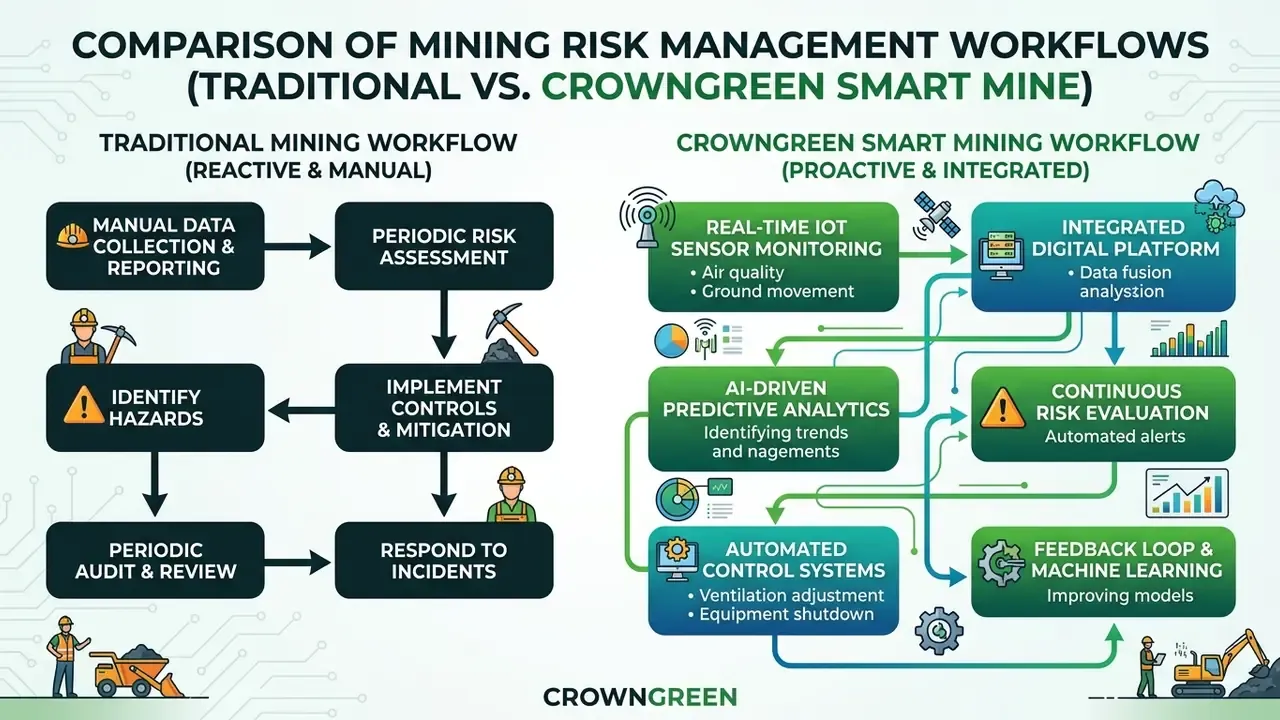
Caption: Diagram comparing low-risk early cash-out workflows against high-risk multi-tile workflows in Mines.

Low-risk approach: fewer mines and an early cash out

A low-risk strategy typically uses 1 to 3 mines on the grid, with the player opening only 1 or 2 safe cells before clicking cash out. This configuration yields high round win frequency, roughly 80% to 92% per round, and generates modest, steady multiplier increments between 1.05x and 1.20x.

Where the 80% to 92% band comes from. Using the payout matrix above: 2 mines with a single click succeeds 92% of the time (23/25); 1 mine with two clicks succeeds 92% of the time; 3 mines with two clicks succeeds 77% of the time; and 5 mines with one click succeeds 80% of the time. So 80% to 92% describes the realistic corridor for one-to-two-click cash-outs at low mine counts, again a direct arithmetic result rather than a guess.

Mathematically, this approach minimizes short-term variance and extends session length, yet expected value ($EV$) stays negative because of the built-in house edge. A single mine hit forfeits your accumulated stake and takes several successful low-risk rounds to recover. Formally, $EV = P(\text{survive } k) \times \text{payout}(k) - 1$, and because the payout table is priced below fair odds, the result stays below zero at every mine count.

Low-risk approach fewer mines and an

Positive progression in numbers: the Paroli system in Mines

Paroli is the mirror image of Martingale: the stake doubles only after a win, and resets to the base unit after a loss. The goal is to bank three consecutive wins at around 2.00x, for example 2 mines on a 5×5 grid with three safe clicks, or 1 mine with a 2.14x target, and then start over.

RoundStakeAction / resultMultiplierRound resultNet profit
1$1 CADWin (advance to step 2)2.00x+$1 CAD+$1 CAD
2$2 CADWin (advance to step 3)2.00x+$2 CAD+$3 CAD
3$4 CADLoss (reset to step 1)0.00x−$4 CAD−$1 CAD
4$1 CADWin (advance to step 2)2.00x+$1 CAD$0 CAD
5$2 CADWin (advance to step 3)2.00x+$2 CAD+$2 CAD
6$4 CADWin (bank profit, reset)2.00x+$4 CAD+$6 CAD

Extended over 20 rounds with a 2.14x target on a 1-mine board, published walkthroughs of this system typically end within a couple of dollars of break-even; one documented sequence finished at +$1.52 after 20 rounds. The structural weakness is visible in round 3 of the table. Repeatedly losing the third leg of the progression turns a winning session into a slow bleed, and the system depends on short winning streaks that Mines does not promise.

A bankroll grid alternative: the «10 bets» system

A second, notebook-based framework spreads risk across four series of ten rounds at descending mine counts (13 mines, then 8, then 6, then 4) with a cash-out target just above 2x in each series: roughly 2.02x at 13 mines, 2.13x at 8 mines, 2.30x at 6 mines and 2.05x at 4 mines.

SeriesMinesSafe clicks neededTarget multiplierRounds
1131~2.02x10
282~2.13x10
363~2.30x10
444~2.05x10

How it works: you start series 1 at the minimum unit of $1 CAD for all ten rounds. After each round you write down the stake for the next series, one unit higher after a win and one unit lower after a loss, never below the minimum. Series 2 is then played with the ten stakes generated by series 1, and so on; after series 4 you loop back to 13 mines. The system needs a smaller bankroll than Martingale and imposes discipline, but practitioners themselves recommend stopping after 10 to 12 completed lines. Over a long enough run the casino's edge reclaims any short-term gain.

Why betting systems never guarantee a win

Progressive betting systems such as Martingale (doubling your bet after a loss) or D'Alembert fail to overcome the house edge in Mines because of table bet limits and finite player bankrolls. A 2023 study on betting progressions published by the University of Chicago REU demonstrated that no staking sequence can transform a negative-expectation process into a positive long-run return.

«In any negative-expectation game, a player's fortune under any admissible strategy forms a supermartingale; its expected value never increases over time.» UChicago REU, Martingales in Gambling and Finance (2023).

As analysed in Pflaumer's UNLV statistical report on martingale progressions, doubling strategies simply trade frequent small profits for infrequent, catastrophic bankroll wipes during an extended losing streak. In rapid digital games like Mines, an unlucky sequence of picks can exhaust table limits or your session budget within minutes.

«Expected profit under a martingale progression is identical to flat betting, but variance and risk of ruin are substantially higher.» Pflaumer, statistical analysis of the martingale in roulette, UNLV International Gaming Institute.

Universal habits that outperform any system

  • Set a hard spending limit before you open the game, and treat it as entertainment cost rather than investment capital.
  • Pick the framework that matches your temperament. A system you cannot follow is worse than flat betting.
  • Define three numbers in advance: stake per round, stop-win, stop-loss.
  • Control emotion. Never raise stakes to «get even» after a bad sequence.
  • Check the promotions page for eligible offers, whether that is a cash match or a free spins package on slots, but read the wagering terms before opting in.
  • Rehearse everything in demo first, including the cash-out target and mine count.
Universal habits that outperform any system

Real-money Mines casino play: access to offers and bonuses

Moving to real money Mines starts with choosing a licensed online casino that supports CAD payments, offers fair bonus terms and enforces clear player-protection controls. Before you pick an operator, weigh deposit requirements, wagering contributions and withdrawal processing speeds.

How to shortlist an operator before you look at the bonus

  1. Licence: provincially regulated platforms operate under iGaming Ontario and the AGCO for Ontario residents; many offshore-facing brands serving other provinces hold Kahnawà:ke Gaming Commission, Malta or Curaçao licences. Verify the licence number in the site footer.
  2. Currency: the account must be denominated in CAD to avoid conversion spreads on every deposit and withdrawal.
  3. Payments: Interac e-Transfer and Interac Online are the fastest Canadian rails. Deposits are usually instant, and approved withdrawals commonly land in 15 minutes to 2 hours, with 1 to 2 business days at slower operators. E-wallets settle in hours; card withdrawals typically take 2 to 5 business days.
  4. KYC: upload ID and proof of address before your first cash-out request, not after. This is the single most common cause of «slow payout» complaints.
  5. Game section: in a game casino lobby, Mines usually sits under Instant Win, Crash or Originals, not in the slots list.
Real-money Mines casino play access to

Compliance disclaimer: real-money online casino gambling is restricted to adults aged 19+ (18+ in AB, MB and QC) residing in legal Canadian jurisdictions. Welcome bonuses often exclude or limit instant-win and crash games like Mines from 100% wagering contribution. Always read the fine print of promotional terms, check maximum cashout limits, and verify operator licensing (for example iGaming Ontario, the Kahnawà:ke Gaming Commission or another recognised regulator) before making a deposit.

Offer feature / parameterStandard casino offerCritical terms to checkWhat this means for you
Mines game availabilityOffered in Instant Win / Crash sectionProvider version (Spribe, Hacksaw, Turbo Games)Make sure your preferred Mines variant, and its RTP of 98% versus 95%, is available in CAD.
Welcome bonus match100% deposit match up to $200 to $1,000 CADWagering contribution tableMines may contribute 0% to 10% toward wagering requirements.
Max bet restrictions$5.00 CAD max bet during bonus playBonus T&C fine print clauseExceeding the maximum bet limit can void bonus winnings.
Payment optionsInterac, e-wallets, credit cardsProcessing speed and CAD supportInterac e-Transfer offers direct bank payouts without conversion fees, typically 15 minutes to 2 hours.
Withdrawal limits$2,000 to $5,000 CAD per transactionIdentity verification (KYC) rulesAccount verification must be completed before your first cash-out.

Worked example of the wagering trap. Deposit $100 CAD with a 100% match and a 20x wagering requirement on deposit plus bonus, and the nominal turnover is 20 × $200 = $2,000 CAD. But if Mines contributes only 5% toward wagering, every $1 you bet counts as 5 cents, so you would need roughly $40,000 CAD in Mines turnover to clear the same bonus. On a 98% RTP game, that volume of wagering carries an expected cost far larger than the bonus itself. If the contribution table caps instant-win games, clear the bonus on eligible games, or decline the bonus and play Mines with cash.

In our editorial research on Canadian operator frameworks, the review process is designed to test sign-up, deposit, bonus activation and cash-out processing before scoring any platform. During an evaluation of iGaming casino platforms, we saw instant-win games capped at 5% game contribution for bonus wagering, which means reading clause details line by line to avoid unexpected bonus cancellations.

Bonus mechanics also shift behaviour measurably, which is why we treat promotions as a risk factor rather than pure value:

Worked example of the wagering trap

«Inducements increased wagering by 11% (€34.09 vs €30.78) and tripled the likelihood of choosing disadvantageous bets.» Newall et al., Effects of Inducements on Sports Gambling and Decision Errors, Journal of Behavioral Addictions (2025).

Mines mobile and download: playing on your phone

Mines mobile gaming is delivered through responsive HTML5 architecture, which allows instant browser play on iOS and Android smartphones without a standalone app download. The game grid, touch controls and cash-out buttons scale automatically to the screen; Hacksaw's build also lists Windows and macOS support through the same HTML5 client. In other words, no mines download is required, and any «official app» promising exclusive odds deserves suspicion.

Two practical mobile risks deserve attention. First, mis-taps: on a 5-inch screen the 25 tiles of a 5×5 grid sit close together, and on a 7×7 or 9×9 board they are smaller still, so an accidental tap can end a round you meant to cash out. During demo testing on an older Android phone, two of my first 30 rounds ended on a stray thumb rather than on a mine. Use auto-cashout to pre-commit your exit, enable move-confirmation if the build offers it, and skip turbo mode until the tap targets feel natural. Second, session creep: rounds last 5 to 30 seconds, so a «quick game» can quietly turn into hundreds of wagers.

Research by Gainsbury et al. (2017) on mobile gambling psychology notes that smartphone access increases both convenience and session frequency.

Mines mobile and download playing on

«Online gambling on mobile devices is associated with higher rates of problem gambling than desktop or land-based formats.» Gainsbury et al., Understanding the Psychology of Mobile Gambling (2017).

«Players who preferred mobile access showed higher levels of problem gambling even after adjusting for demographic variables (N = 4,482).» Is all Internet gambling equally problematic?, observational study using propensity score matching.

Because mobile play travels with you, setting daily deposit limits and session-time reminders is essential to keep the game entertainment and keep it inside budget.

Responsible gambling disclaimer. This information is general in nature and does not replace professional advice. Online gambling is available only to adults in jurisdictions where it is legal. If gambling stops being entertainment, contact a problem-gambling helpline. In Canada, ConnexOntario and provincial support services offer free, confidential help 24/7.

FAQ: Mines questions Canadian players ask

Bottom line and pre-deposit checklist

Mines is an engaging, fast-paced chance game where player choice controls round timing while the house edge dictates long-term math. Explore the free demo to learn the grid mechanics, verify casino licensing and T&Cs before wagering real money, set firm limits, and play responsibly (19+).

What to do next

  • Play 30 to 50 demo rounds and note how the multiplier and survival odds move with different mine counts.
  • Confirm the provider badge (Spribe, Hacksaw or Turbo Games) and its RTP before betting real money.
  • Verify one Provably Fair round end-to-end in demo.
  • Check the licence (iGaming Ontario, Kahnawà:ke or equivalent) and CAD support.
  • Read the bonus contribution table and run the turnover math before opting in.
  • Complete KYC before your first withdrawal request.
  • Set deposit, loss and session-time limits, plus an auto-cashout target.
  • Decide your stop-win and stop-loss numbers, then close the tab when you hit either.

Compare on the facts, read the terms before you deposit, and play responsibly. 19+.

Bottom line and pre-deposit checklist. Mines

Appendix A: editorial revision notes

Retained for transparency; the main text above supersedes these earlier formulations.

  1. RTP range. Original wording: «Return to Player (RTP) in Mines typically ranges between 96% and 97%.» Updated because provider documentation records 98.00% (Spribe, Hacksaw Gaming) and 95.00% (Turbo Games).
  2. Cash-out behaviour citation. Original wording: «As documented in crash game research by Scott and Sher (2023), most players naturally cash out at modest multipliers (around 1.50x to 2.00x).» Replaced with a quantified quotation from the same source.
  3. Demo psychology citation. Original wording: «Research published in PubMed (2014) showed that free-play exposure and inflated demo sessions can artificially elevate risk tolerance when transitioning to real stakes.» Replaced with named, verifiable studies (Ball State University 2023; James et al. 2019); the underlying claim about inflated risk tolerance is retained in the main text.
  4. Mobile gambling citation. Original wording referenced Gainsbury et al. (2017) without its key finding; the finding is now quoted directly and supplemented with propensity-score-matched evidence.
  5. RTP report citation. The reference to Sterner et al. (2023) now carries the report's specific figure of roughly 96%.
  6. Disclaimer artefact. The string «(otherwise: no data)» was an internal placeholder and has been removed from the compliance disclaimer.
  7. Grid scope. The original text described the 5×5 grid as the only format; the alternative 3×3, 7×7 and 9×9 boards from Hacksaw Gaming have been added.
Appendix A editorial revision notes. Retained